

Architects face real financial risk every time they complete a project. A single design oversight or miscommunication can trigger costly claims that threaten your firm’s reputation and bottom line.
Professional liability for architects isn’t optional-it’s a business necessity. We at Tower Insurance Associates, Inc. help firms understand what protection actually covers, where gaps exist, and how to build stronger risk management practices from the ground up.
Common Claims Against Architects
Design Defects: The Costliest Exposure
Design defects represent the largest category of professional liability claims against architects, accounting for approximately 35-40% of all claims filed. These aren’t minor issues-they range from structural miscalculations that require costly remediation to aesthetic failures that damage client relationships. A single design error spirals into construction delays, material waste, and expensive rework that clients expect you to cover. The financial exposure is substantial: claims for design defects average $150,000 to $500,000 depending on project scope and the severity of the deficiency.
Building Code Violations and Regulatory Risk
Building code violations compound this risk significantly. The International Building Code updates every three years, and staying current requires active monitoring of changes in your jurisdiction. Non-compliance with current codes doesn’t just trigger claims-it exposes you to potential legal liability beyond insurance coverage. Architects who rely on outdated standards or fail to verify code requirements before finalizing designs face claims that extend beyond typical coverage limits. This regulatory exposure demands continuous attention to your local and state requirements.
Communication Breakdowns That Escalate Disputes
Communication failures during project delivery generate a surprising volume of claims. When architects don’t document decisions, fail to respond to contractor requests promptly, or leave ambiguities in specifications, disputes escalate quickly. These aren’t always about technical failures-they’re about unclear expectations and poor record-keeping that make your firm’s position indefensible when conflicts arise.
The Documentation Gap That Costs Firms
Most architects underestimate how often communication failures lead to claims. Poor documentation of client meetings, design changes, and site decisions creates situations where your firm’s position becomes indefensible. Architects who maintain detailed project logs, email trails, and meeting minutes reduce their exposure dramatically. You should document every significant decision and change order immediately-not retrospectively. Specify exactly what you agreed to, who approved it, and when. This practice alone prevents roughly 30% of preventable claims.
Scope Definition and Contract Clarity
Project management failures also stem from unclear scope definition. When contracts don’t explicitly define what’s included in your services versus what falls on the contractor or owner, disputes multiply. You should specify deliverables, timelines, and communication protocols in writing before work begins. Many architects skip this step, assuming shared understanding (a costly assumption). The gap between what you think you promised and what clients believe they purchased creates the conditions for claims that professional liability insurance must address.
Coverage Options and What Professional Liability Protects
What Standard Professional Liability Covers
Professional liability insurance protects your firm from the financial fallout of design errors, code violations, and communication failures-but the protection isn’t unlimited. Standard policies cover defense costs, settlements, and judgments arising from claims that you failed to perform your professional duties with reasonable care. This means coverage applies when clients sue over design defects, missed building code requirements, or inadequate project management. However, the policy limits matter significantly. Most architects carry $1 million per claim and $2 million aggregate coverage, though firms handling larger projects often need $2 million per claim limits. The National Council of Architectural Registration Boards doesn’t mandate specific coverage amounts, leaving this decision to individual firms-a gap that creates real exposure for undercovered practices.
Defense Costs and Policy Structure
Your policy should explicitly cover defense costs outside the policy limit, which separates better policies from weak ones. Some carriers include defense costs within the limit, meaning a $100,000 legal bill reduces your available coverage for settlement or judgment. This structural difference matters enormously when claims become contested. A policy that places defense costs outside the limit preserves your full coverage amount for actual settlements or judgments, while policies that bundle defense costs inside the limit erode your protection dollar by dollar as legal fees accumulate.
Common Coverage Gaps and Exclusions
Gaps emerge quickly when you examine what standard policies exclude. Contractual liability for penalties you agreed to pay clients sits outside most basic coverage unless you purchase an endorsement. If your contract requires you to pay liquidated damages for schedule delays, standard professional liability won’t cover those payments. Pollution liability, technology errors, and employment practices liability require separate policies. More importantly, claims-made policies leave you exposed during coverage gaps when you change carriers or let a policy lapse. A claim filed six months after your policy ends receives no coverage if you’ve switched insurers.
Tail Coverage and Claims Advocacy
Tail coverage extends reporting periods when you retire or sell your practice, protecting you from claims filed years after you stop working. Your carrier should also provide claims advocacy, meaning they assign experienced counsel who understands architectural practice rather than generic defense attorneys. This distinction affects claim outcomes substantially-counsel familiar with design standards and industry practices defends your position far more effectively than lawyers handling general commercial claims. The quality of your carrier’s claims advocacy team directly influences whether you win disputes or settle unfavorably.
Evaluating Your Current Protection
These coverage details reveal why many architects operate with inadequate protection. You need to examine your current policy limits, verify that defense costs sit outside your limit, and confirm your carrier assigns specialized counsel for architectural claims. The gaps in standard coverage (contractual liability, pollution, technology errors) require separate endorsements or policies to address your firm’s actual exposure. Understanding these distinctions positions you to build a comprehensive protection strategy that covers both common claims and the specialized risks your practice faces. Get professional advice on the right coverage for your firm’s needs.
Risk Management Systems That Stop Claims Before They Start
Document Every Design Decision in Writing
Documentation practices separate firms that face constant claims from those that operate cleanly for years. The difference isn’t talent or experience-it’s systematic record-keeping that creates an undeniable paper trail. You should document every design decision in writing before implementation, not after disputes arise. This means email confirmations of client approvals, meeting minutes that specify what was discussed and decided, and dated records of scope changes.
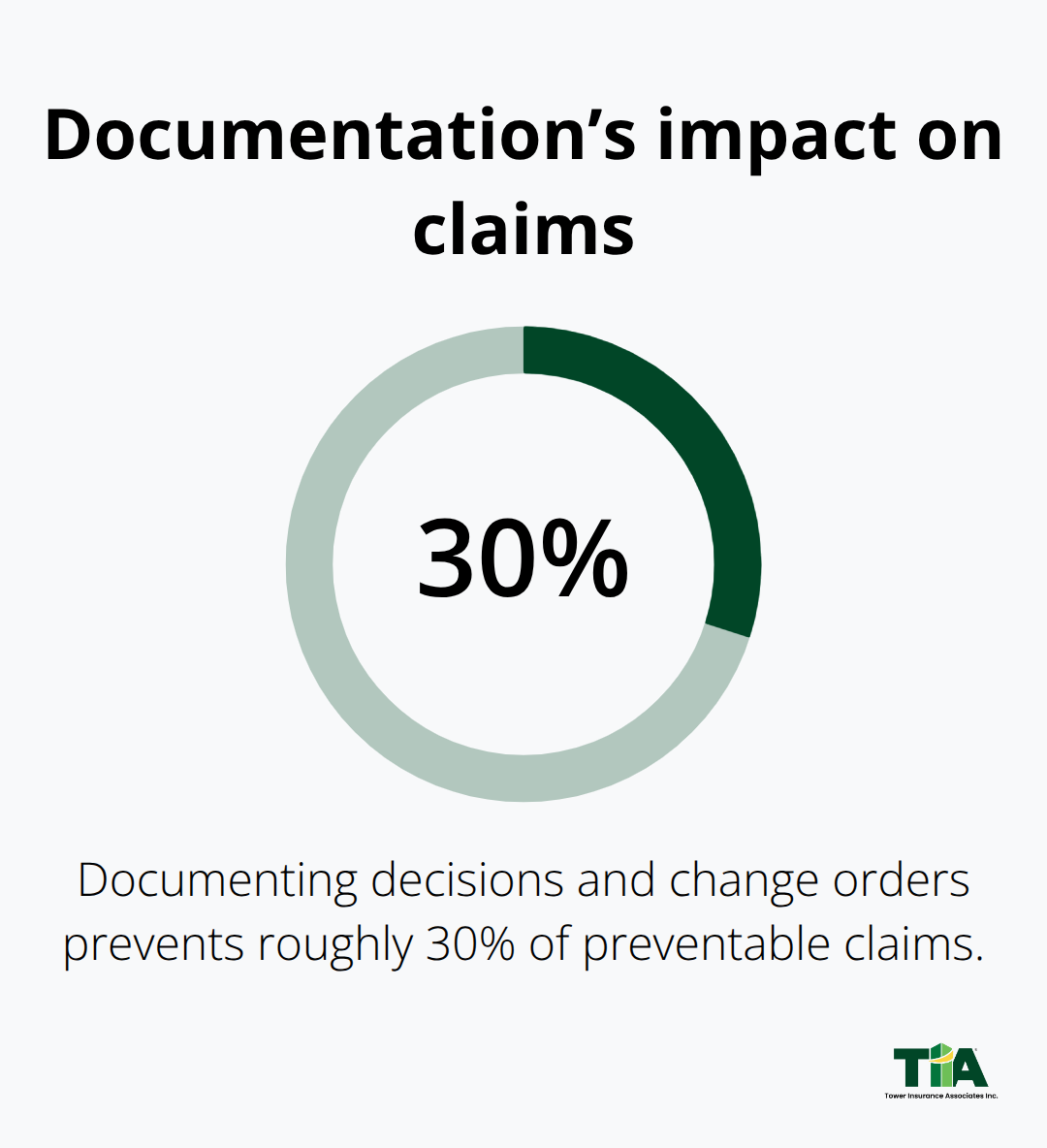
Architects who maintain detailed project logs reduce their exposure according to claims data from professional liability carriers.
Your contracts should explicitly define what services you’re providing, what the client is responsible for, and what falls to contractors. Many firms still rely on vague language about design services without specifying deliverables, review cycles, or approval processes. This ambiguity creates disputes that insurance must cover. Instead, spell out exactly what you’ll provide-number of design revisions, specific drawing sets, site visit frequency, and communication protocols. Include clear timelines for client decisions and approval processes. When clients delay approvals, your contract should capture this impact on the project schedule. This protects you from claims that you caused delays when the actual delay originated with the client’s slow decision-making.
Implement Peer Review and Quality Control
Quality control processes require more than hoping your team catches errors. You should establish a mandatory peer review system where someone other than the original designer examines all design documents before they leave your office. This second set of eyes catches dimensional errors, code conflicts, and specification gaps that the original designer missed. The review should be documented in writing-who reviewed it, when, and what issues were identified and corrected.
Building code compliance demands active verification, not passive assumption. You should assign one person responsibility for tracking code updates in your jurisdiction and communicating changes to your team quarterly. When you begin a project, you should verify current code requirements in writing and document which version of the code you’re designing to. This protects you when codes change mid-project.
Maintain Current Knowledge Through Continuing Education
Continuing education isn’t optional if you want to reduce claims. Architects who complete annual training in current code requirements, contract law, and risk management file fewer claims than those who don’t. The American Institute of Architects offers continuing education programs specifically designed for liability reduction. You should track completion dates and maintain records of what your team learned. When a claim arises, you can demonstrate that your firm maintains current knowledge of standards and regulations, which strengthens your defense significantly.
Final Thoughts
Professional liability for architects demands your attention across three areas: your insurance coverage, your internal processes, and your team’s knowledge. Firms that win disputes and avoid costly settlements share common practices-they document decisions in writing before disputes arise, they implement peer review systems that catch errors before clients see them, and they maintain current knowledge of building codes and contract law. Your professional liability insurance forms the financial foundation, but it cannot substitute for strong risk management practices that prevent claims from occurring in the first place.
The gaps in standard coverage we discussed earlier require immediate attention from your firm. Review your current policy limits, verify that defense costs sit outside your limit, and confirm your carrier provides specialized counsel for architectural claims. If your policy lacks coverage for contractual liability or other specialized risks your practice faces, you should address these gaps now rather than discovering them during a claim.
We at Tower Insurance Associates, Inc. work with architectural firms throughout California to build comprehensive protection strategies tailored to your specific practice. As an independent agency representing multiple top-rated carriers, we find coverage that actually fits your firm’s needs and risk profile. Contact us to evaluate your current coverage and identify any protection gaps before they become expensive problems.
Disclaimer: This blog post is for general informational purposes only and does not represent actual coverage, policy terms, or legal requirements. Insurance details vary by individual and jurisdiction. Please consult a licensed insurance professional for advice specific to your situation.