

California healthcare providers face unique liability risks that demand specialized protection. Medical professional liability in California involves complex state regulations, high claim costs, and practice-specific exposures that standard policies often miss.
At Tower Insurance Associates, Inc., we work with physicians, dentists, and other healthcare professionals to build coverage strategies that address these realities. The right policy protects your practice, your assets, and your ability to continue serving patients.
What Medical Malpractice Actually Costs California Providers
How California Law Defines Medical Malpractice
Medical malpractice in California carries specific legal meaning that differs from negligence in other contexts. Under California law, a healthcare provider commits malpractice when they fail to exercise the degree of care, skill, and diligence that other reasonably careful practitioners would use under similar circumstances, and this failure directly causes injury to the patient. The Medical Injury Compensation Reform Act of 1975, commonly known as MICRA, established the legal framework that still governs claims today. MICRA caps non-economic damages at $250,000 while leaving economic damages like lost wages uncapped, which has made California one of the most stable medical malpractice markets in the United States. This stability attracts multiple carriers to the state, but it does not eliminate the financial exposure providers face.
What Triggers Claims Most Often
Misdiagnosis or delayed diagnosis remains the most frequent trigger for claims, followed by incorrect prescriptions, negligent treatment decisions, and unsafe care practices. The American Medical Association reports that about 5 to 6 insured physicians per 100 in private practice experience a malpractice claim in any given year, though claim frequency has actually declined since 2007. In 2024, only 1.8 percent of physicians were sued in the prior 12 months, down from historical averages exceeding 7 percent. However, frequency decline masks a troubling reality: severity is rising sharply.
The Rising Cost of Claims
Claim costs in California have accelerated despite flat or declining frequency trends. Milliman’s 2023 medical professional liability analysis, using 2022 data from hospitals and long-term care facilities, documented over $22 billion in incurred losses across the sector. Large indemnity payments have become more common, with the share of closed claims involving indemnity payments of $1 million or more gradually increasing since 2008. Payments of $5 million or more have risen even faster, and the frequency of $10 million-plus indemnities is expanding, signaling growing tail risk from catastrophic claims. The loss expense ratio has actually declined in recent years even as indemnity amounts rise, indicating a shift toward larger settlements relative to defense costs. Third-party litigation funding has emerged as a possible driver accelerating large claims.
Premium Costs by Specialty
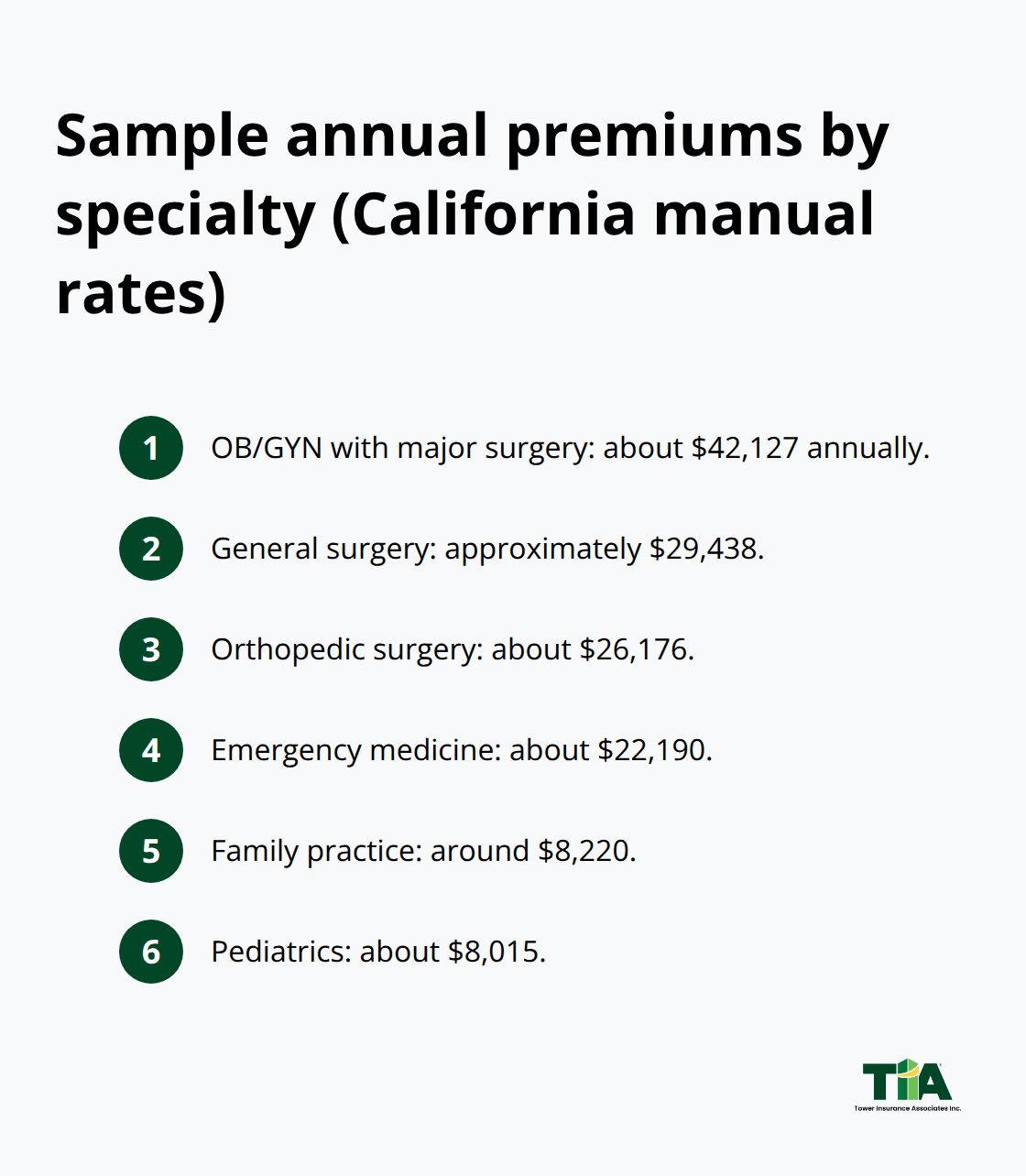
For California physicians, average premiums for $1 million per occurrence and $3 million aggregate coverage vary significantly by specialty according to state-filed data. Obstetrics and gynecology with major surgery averages about $42,127 annually, while general surgery runs approximately $29,438, orthopedic surgery about $26,176, and emergency medicine about $22,190. Lower-risk specialties like family practice average around $8,220 and pediatrics about $8,015. These manual rates serve as benchmarks, but carriers typically offer discounts up to 50 percent off state-filed rates, making personalized quotes essential for accurate budgeting.
Your actual premium will depend on your location within California, your specific specialty, your claims history, and the coverage limits you select.
Understanding these costs and trends helps you recognize why your practice needs coverage tailored to your specific risk profile and patient population. The next section examines the policy structures available to California providers and how to select the right protection strategy for your situation.
Picking the Right Policy Structure for Your Practice
Occurrence Policies vs. Claims-Made Policies
Choosing between occurrence and claims-made policies fundamentally changes how your practice manages liability exposure and long-term costs. Occurrence policies cover incidents during the policy period regardless of when claims are filed. If a patient injury occurs in 2026 while your policy is active, you receive coverage even if the claim arrives in 2029 or later. A claims-made policy, by contrast, only covers claims actually filed while your policy is in force. Claims-made policies typically cost 30 to 40 percent less in year one because insurers face shorter reporting windows and faster claims closure. However, this savings disappears once you hold the policy for several years, and premiums rise as your practice accumulates claim history. Milliman’s analysis of medical professional liability data shows that claims-made policies remain the most common structure among California healthcare providers, largely because of lower initial costs.
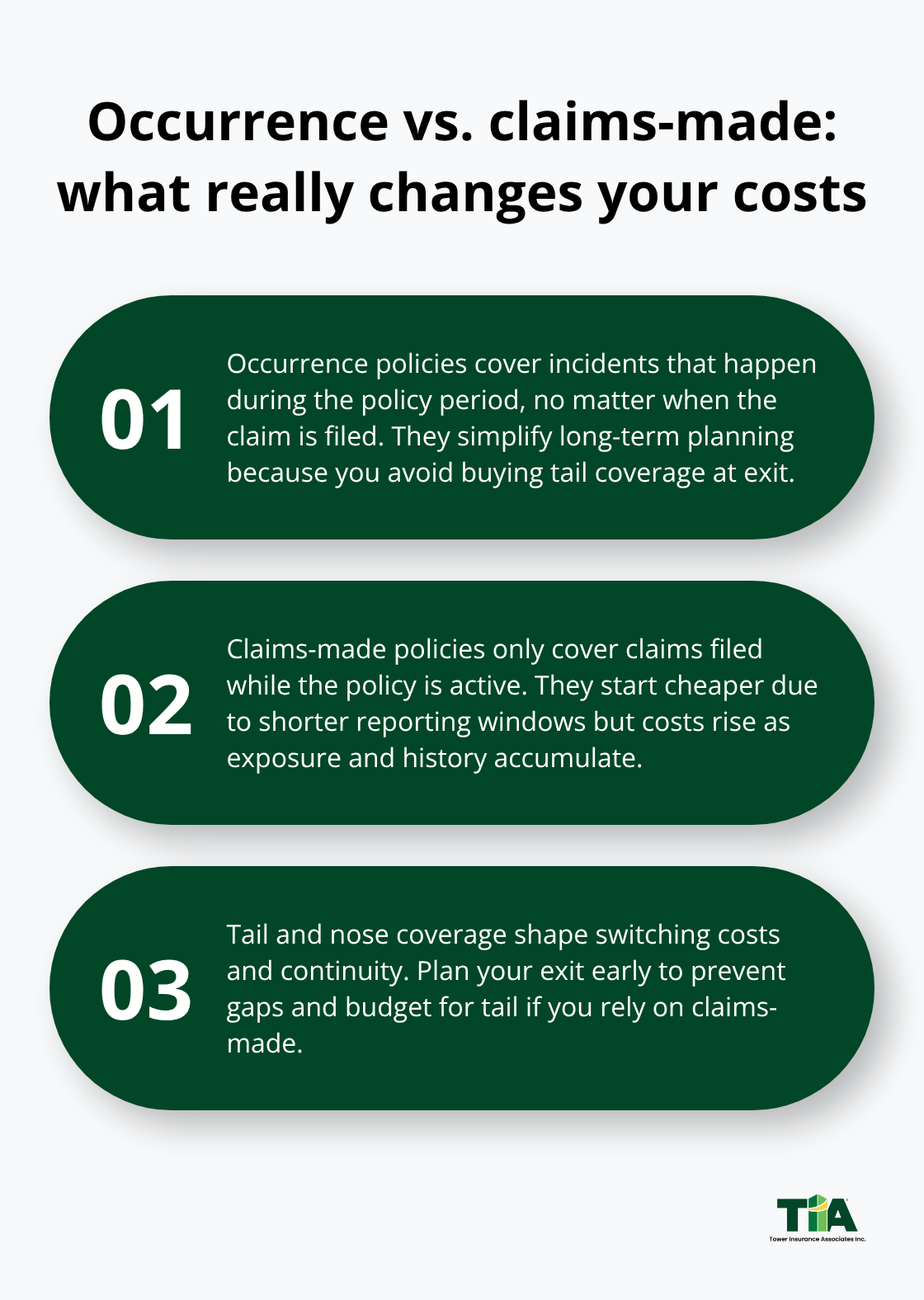
The trap many providers fall into involves underestimating the true cost of switching policies. When you move from one claims-made policy to another, you create a coverage gap unless you purchase tail coverage, which extends your reporting period after your old policy ends. Occurrence policies make financial sense for practices planning to operate long-term in California because the premium difference narrows considerably after five years, and you eliminate the administrative burden of managing tail coverage when you retire or relocate. For younger practitioners or those in volatile practice situations, claims-made policies make financial sense if you commit to purchasing tail coverage as an exit strategy.
Tail Coverage and Prior Acts Protection
Tail coverage deserves careful attention because most practices underestimate its cost and importance. Tail coverage, also called extended reporting period coverage, typically runs 150 to 300 percent of your annual premium and covers claims filed after your policy ends. If you carry a $30,000 annual premium and purchase tail coverage, you pay $45,000 to $90,000 for protection that lasts one to three years after you stop practicing. Most hospitals and healthcare systems require tail coverage as a condition of employment termination or practice sale, so this isn’t optional for most providers.
Nose coverage, sometimes called prior acts coverage, works the opposite direction by providing retroactive protection on a new policy for incidents that occurred before you switched carriers. When you transition between insurers, nose coverage prevents gaps in your defense history and ensures seamless protection. This combination of tail and nose coverage matters especially when you change carriers or modify your practice structure.
Higher Limits for High-Risk Specialties
For healthcare providers with high-risk specialties, additional coverage layers matter significantly. Obstetrics and gynecology practices, surgical specialties, and emergency medicine providers face the highest indemnity exposure according to Milliman’s data, with $10 million-plus claims increasing in frequency. These specialties should consider coverage limits above the standard $1 million per occurrence and $3 million aggregate. Many California practices pair professional liability with cyber insurance to protect against patient data breaches, ransomware, and HIPAA violations, which create separate liability exposure that standard malpractice policies exclude.
Your coverage strategy must reflect your actual patient population, your specific procedures, and your geographic location within California, since claim severity varies substantially by county and specialty mix. An independent insurance agency can help you evaluate whether your current limits match your actual exposure and identify gaps that standard policies leave unprotected. The next section examines how state regulations and your specific practice characteristics shape the coverage you truly need.
Why Your Practice Size and Specialty Shape Coverage Needs
California’s Regulatory Requirements for Healthcare Providers
California healthcare providers operate under regulations that directly mandate professional liability coverage in specific situations. Shareholders of professional medical corporations, partners in medical LLPs, and Registered Foreign Legal Consultants must maintain malpractice insurance by law, though solo practitioners face no statutory requirement. However, hospitals, medical groups, and credentialing bodies almost universally require physicians to carry coverage as a condition of employment or privileging, making the practical requirement nearly universal despite the legal exemption for some practitioners. Beyond malpractice insurance itself, California law mandates workers’ compensation coverage for any practice with employees and typically requires commercial general liability if you lease office space, since landlords contractually demand proof of coverage before signing leases.
This regulatory stacking means most healthcare practices must juggle multiple mandatory policies simultaneously, and gaps between them create uninsured exposure. Your practice structure determines which regulations apply most directly to your situation, so you need to map your specific entity type against state requirements rather than assume standard coverage applies.
Matching Retention and Limits to Your Practice Size
Your practice size directly determines the retention levels and aggregate limits that make financial sense. Small healthcare systems typically maintain median retentions around $1 million, medium-sized systems around $2 million, and large systems around $6 million.
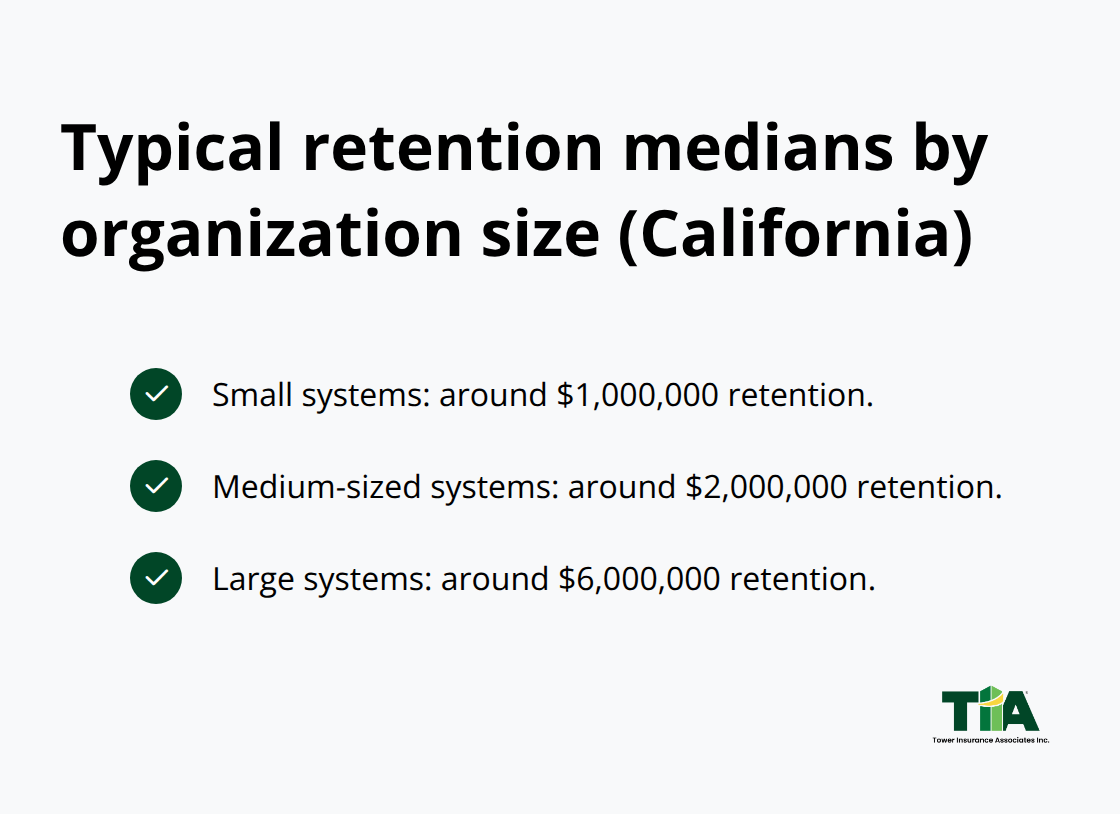
These retention figures reflect both the financial capacity to absorb losses and the negotiating power larger organizations command with insurers.
A solo practitioner or small group cannot absorb a $2 million retention without devastating cash flow, so your actual retention should match your liquid reserves and revenue stability. High-risk specialties like obstetrics, general surgery, and orthopedic surgery warrant higher aggregate limits because indemnity payments are increasing in frequency, and your specialty mix directly predicts claim severity in your county. Emergency medicine practices in urban California face different exposure than rural family medicine practices, and your geographic location within the state matters because claim severity varies substantially by county.
Specialty-Specific Exposure and County-Level Risk
Your specialty distribution and patient population directly shape the coverage you actually need. High-risk specialties face substantially higher indemnity exposure than lower-risk fields, and this variation extends across California counties. Practices that operate across multiple counties or serve diverse patient populations should evaluate their exposure at the county level rather than relying on statewide averages, since clear cross-county differences exist in claim severity and frequency patterns.
When you assess your actual specialty mix, you must account for procedures you perform regularly, not just your primary classification. A family medicine practice that performs minor surgical procedures faces different exposure than one offering only office-based care. This honest assessment of what your practice actually does, not what you think it does, determines whether your current limits adequately protect your assets.
Claims Advocacy and Risk Management Support
Risk management support and claims advocacy distinguish adequate policies from truly protective ones. Many carriers provide practice hotlines for immediate guidance when adverse events occur, MCLE courses that reduce claim frequency through better documentation and communication practices, and dedicated claims advocates who defend your interests rather than simply processing paperwork. These services directly reduce both the likelihood and severity of claims-practices with strong incident reporting systems and proactive risk management see lower claims frequency, yet many providers purchase policies without evaluating what support services actually come included.
When you evaluate carriers, ask specifically whether they provide pre-incident risk consultation, whether their claims counsel can be selected by your practice rather than appointed by the insurer, and whether they offer coverage for State Bar or regulatory investigations that fall outside traditional malpractice claims. These details matter more than premium price because a $2,000 annual savings on premium disappears instantly if your carrier assigns you inadequate defense counsel during a complex case. An independent insurance agency that represents multiple top-rated carriers can help you compare what each carrier actually provides beyond the policy document itself.
Final Thoughts
Medical professional liability in California demands coverage that matches your actual practice, not generic policies that leave exposure unaddressed. Your specialty, county location, and practice structure directly predict claim severity, so standard limits may fail to protect your assets if you practice high-risk medicine or serve complex patient populations. Occurrence policies eliminate tail coverage expenses when you retire, while claims-made policies save money initially but require careful exit planning to avoid gaps in protection.
We at Tower Insurance Associates, Inc. represent multiple top-rated carriers and compare what each insurer actually provides beyond premium price, including claims advocacy, risk management support, and coverage for regulatory investigations. We help you evaluate whether your current limits adequately protect your assets and structure your coverage for your specific practice stage and specialty mix. Contact Tower Insurance Associates, Inc. to discuss your practice structure, specialty, and current coverage so we can provide personalized service and competitive quotes from carriers that understand California’s unique liability environment.
Disclaimer: This blog post is for general informational purposes only and does not represent actual coverage, policy terms, or legal requirements. Insurance details vary by individual and jurisdiction. Please consult a licensed insurance professional for advice specific to your situation.