

One mistake on a tax return or a missed deadline can cost your accounting firm thousands in liability claims. At Tower Insurance Associates, Inc., we’ve seen how quickly a single error can spiral into expensive litigation and damage your reputation.
E&O insurance for accountants in LA isn’t optional-it’s the safety net that keeps your practice standing when things go wrong. This guide walks you through what coverage you actually need and how to find the right policy for your firm.
What E&O Insurance Actually Covers for Accountants
The Core Protection E&O Provides
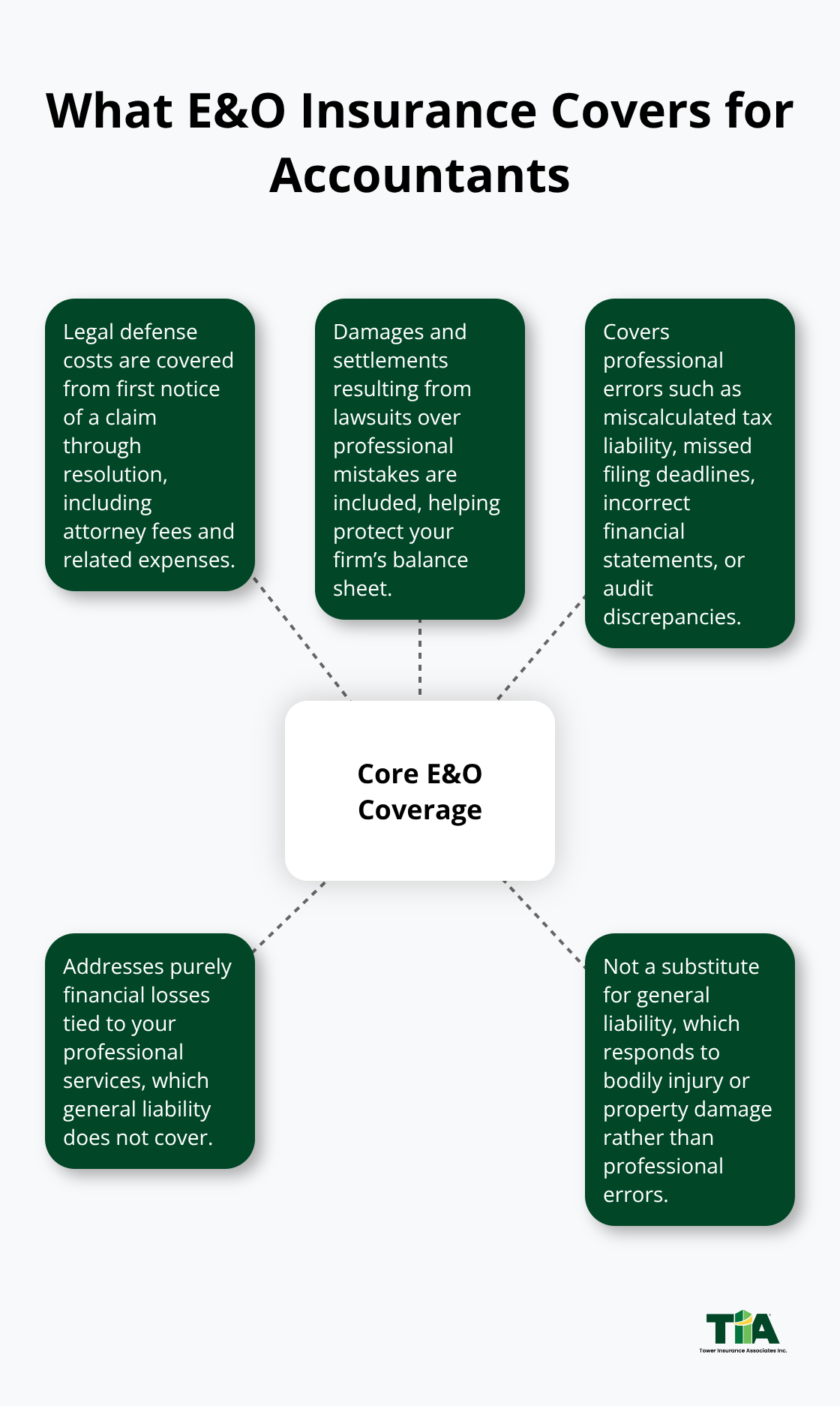
E&O insurance protects your accounting firm when clients claim you made professional mistakes that cost them money. This means coverage applies when a client sues because you miscalculated their tax liability, missed a filing deadline, prepared an incorrect financial statement, or failed to catch a discrepancy during an audit. The policy covers your legal defense costs and any damages awarded by a court or settlement agreement.
Unlike general liability insurance, which handles bodily injury or property damage claims, E&O specifically addresses the financial losses that result from your professional work. General liability won’t touch a claim that your tax preparation error caused a client to pay thousands in unexpected taxes and penalties. California courts have consistently upheld this distinction.
Why General Liability Falls Short
In one case documented by the California Society of Certified Public Accountants, a firm without E&O coverage faced over $150,000 in uninsured legal fees alone when defending against a client’s tax preparation claim. General liability simply doesn’t bridge this gap. This gap exists because general liability policies exclude professional services from their protection.
Common Claims Against California Accountants
Claims against accountants in California tend to follow predictable patterns. Tax preparation errors rank as the most common complaint, with missed deductions, incorrect income reporting, and deadline failures leading to substantial client losses. Financial statement misstatements represent the second major exposure, particularly when small business owners rely on your statements for loan applications or business decisions.
Data security breaches and confidentiality violations have surged in recent years as clients store sensitive information with accounting firms. The State Bar of California and various professional organizations note that cybersecurity failures now trigger roughly 15 to 20 percent of E&O claims filed by accounting professionals.
Coverage Limits and Deductibles That Matter
Your E&O policy should explicitly cover legal defense costs, settlement payments, and judgments resulting from these scenarios. Coverage limits matter significantly. Most accounting firms in Los Angeles carry between $500,000 and $2,000,000 in E&O protection, depending on client base size and service complexity.
A solo practitioner serving small businesses might adequately operate with $500,000 coverage, while firms managing multiple clients’ tax audits and financial reporting should consider $1,000,000 or higher. Your deductible typically ranges from $2,500 to $10,000 per claim, and choosing the right deductible depends on your firm’s cash reserves and risk tolerance. These decisions directly impact both your premium costs and your out-of-pocket exposure when a claim occurs.
What Risks Keep LA Accountants Up at Night
Tax Preparation Errors and Their Financial Impact
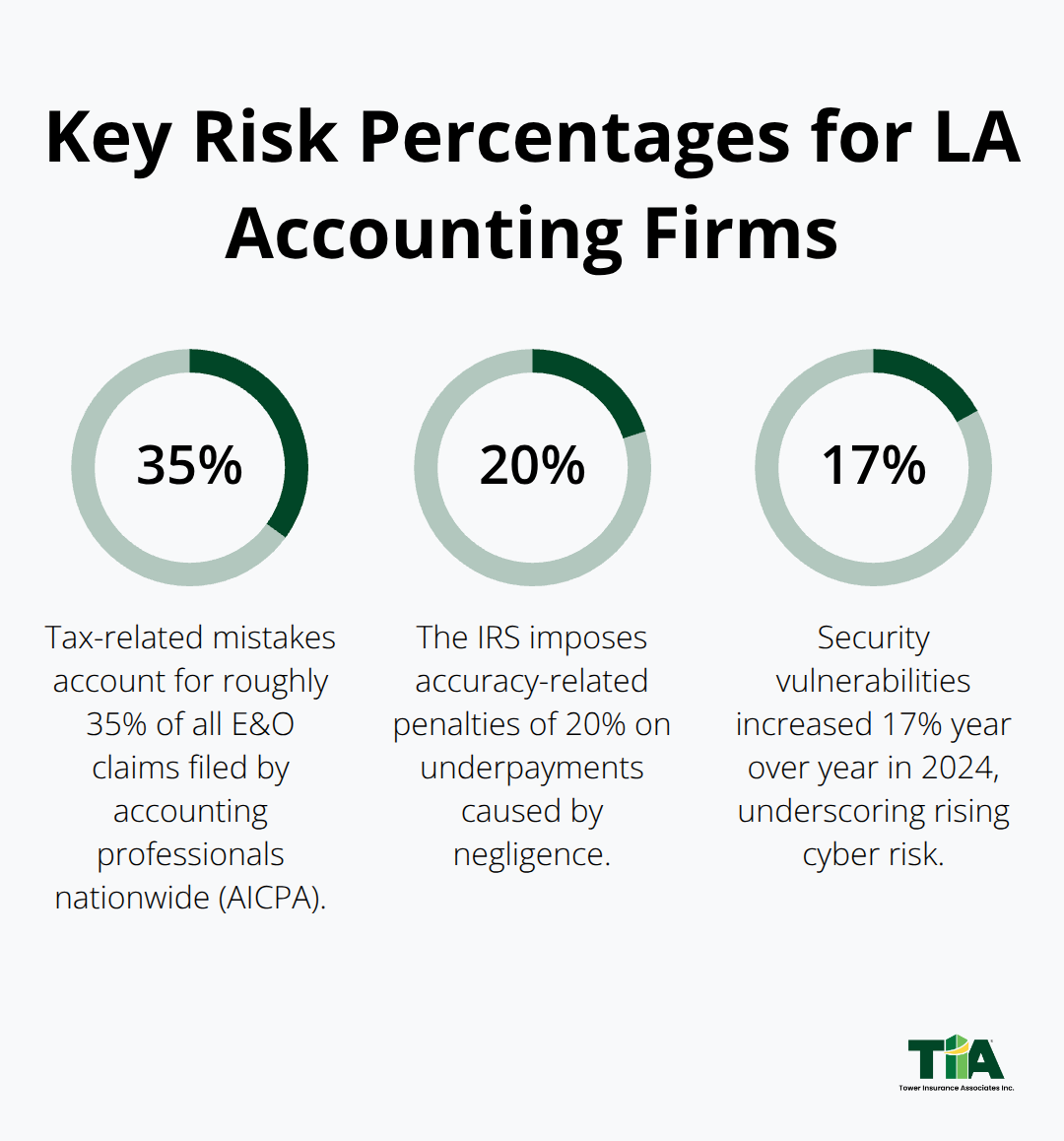
Tax preparation errors dominate the claims landscape for California accountants, and the financial exposure is real. The American Institute of Certified Public Accountants reports that tax-related mistakes account for roughly 35 percent of all E&O claims filed by accounting professionals nationwide. In Los Angeles specifically, where many firms handle high-income earners, real estate professionals, and complex business structures, a single missed deduction or misreported income triggers six-figure liability claims. The IRS imposes accuracy-related penalties of 20 percent on underpayments caused by negligence, and your clients will look to you when they face these bills.
Audit defense costs compound the problem quickly. Defending a client through an IRS examination runs $5,000 to $15,000 in professional fees alone, even before any additional taxes or penalties are assessed. Your E&O policy must explicitly cover these defense costs because clients routinely expect their accountant to absorb these expenses when an error surfaces.
Financial Statement Misstatements and Liability Exposure
Financial statement errors present a different but equally dangerous exposure. Small business owners in Los Angeles rely on your financial statements to secure bank loans, attract investors, or make critical operational decisions. A misstatement that overstates profitability or understates liabilities triggers substantial damages claims when lenders or investors discover the error. These claims often exceed $100,000 because the financial impact ripples across multiple parties who relied on your work.
Data Security Breaches and Regulatory Fines
Data security breaches have become unavoidable for accounting firms holding client tax returns, bank statements, and sensitive personal information. The California Consumer Privacy Act requires notification within 30 days of a breach affecting personal information, and regulatory fines can reach $7,500 per violation. Over 30,000 new security vulnerabilities were identified in 2024, highlighting a 17% year-over-year increase according to industry reports, making this threat impossible to ignore.
Your E&O coverage should include cyber liability components that address notification costs, credit monitoring services, and legal defense related to data breaches. This integrated protection eliminates gaps between E&O and cyber coverage that leave your firm exposed. When selecting your policy, look for carriers offering combined E&O and cyber liability packages specifically designed for accounting practices, as these solutions provide seamless protection across both traditional professional liability and modern digital threats.
Selecting the Right E&O Coverage for Your Accounting Practice
Coverage Limits That Match Your Practice Size
Your E&O coverage limit should reflect the size of your client base and the complexity of work you perform, not industry averages. A solo practitioner handling tax returns for small business owners faces different exposure than a firm managing audit engagements for mid-market companies. The Professional Liability Underwriting Society reports that accounting firms with annual revenues under $500,000 typically carry $500,000 to $750,000 in E&O limits, while firms exceeding $2 million in revenue maintain $1,000,000 to $2,000,000 in protection. This correlation exists because larger practices accumulate greater aggregate exposure across more clients and more complex engagements.
Your deductible selection directly impacts your premium cost and should align with your firm’s cash reserves. A $2,500 deductible reduces your premium by roughly 15 to 20 percent compared to a $1,000 deductible, but only makes sense if your firm can comfortably absorb that out-of-pocket amount without financial strain. Most accounting practices in Los Angeles operate with $5,000 deductibles as the practical middle ground, balancing premium savings against realistic retention capacity. Avoid the temptation to maximize your deductible simply to lower your annual premium, because a claim requiring you to pay $10,000 out of pocket while managing litigation costs creates cash flow problems that damage your business more severely than the premium savings ever justified.
Endorsements That Close Coverage Gaps
Standard E&O policies for accountants exclude certain exposures that create significant liability, and you need specific endorsements to close these gaps. Payroll processing errors represent one critical exposure that requires an explicit endorsement, since standard E&O policies frequently exclude this work. If your firm processes payroll for clients, an endorsement costs roughly $200 to $400 annually but protects you when payroll tax deposits are missed or employee withholding calculations contain errors.
Management consulting services also require separate endorsements if you provide business advisory work beyond traditional accounting and tax preparation. Notary errors and retirement plan administration represent two additional exposures that demand explicit coverage. Cyber liability endorsements have become non-negotiable for accounting firms, as standard E&O policies provide minimal coverage for data breach notification costs, credit monitoring services, and regulatory fines.
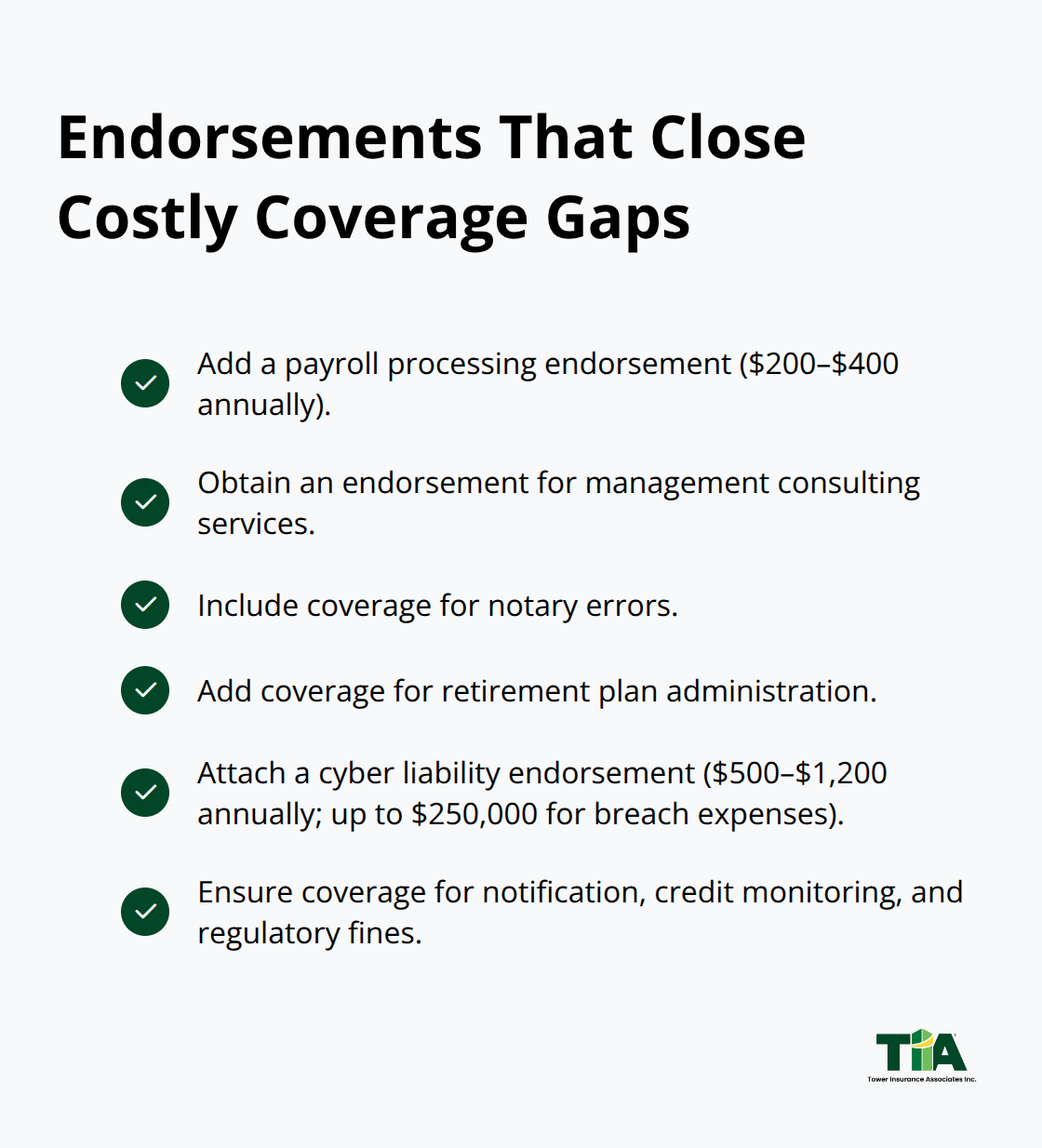
A cyber liability endorsement typically adds $500 to $1,200 annually to your premium but provides coverage up to $250,000 for breach-related expenses. Given that the average cost to notify affected parties of a data breach reached $4.24 per record in 2023 according to IBM’s Cost of a Data Breach report, this endorsement represents essential protection rather than optional coverage.
Obtaining Quotes That Reflect Your Actual Risk
Insurance agents frequently underwrite E&O policies based on incomplete information about your practice, resulting in inadequate coverage or inflated premiums that don’t reflect your actual risk. Provide your agent with detailed documentation of your service lines, client types, annual revenue, number of employees, and claims history before receiving a quote. Agents need to understand whether you handle audit work, tax controversy matters, bookkeeping services, or payroll processing, since each service line carries different underwriting rates and coverage requirements.
Carriers also evaluate your cybersecurity infrastructure, so document your password management protocols, data encryption practices, and employee training programs. Firms demonstrating strong security controls receive premium discounts of 10 to 15 percent compared to firms with minimal cyber protections. Request quotes from at least three carriers before making your selection, because premium rates for identical coverage can vary by 30 to 40 percent depending on how each carrier evaluates your specific risk profile. Tower Insurance Associates represents multiple top-rated carriers, enabling comparison of quotes and identification of coverage that provides genuine value. Avoid selecting coverage based purely on premium cost, because the cheapest policy often excludes endorsements you need or carries coverage limits insufficient for your practice size. Instead, evaluate quotes on a total cost basis that includes your deductible, coverage limits, necessary endorsements, and claims handling reputation of each carrier.
Final Thoughts
E&O insurance for accountants in LA protects your practice from the financial devastation that follows a professional mistake. The coverage limits, deductibles, and endorsements you select today determine whether a single claim bankrupts your firm or becomes a manageable business expense. Tax preparation errors, financial statement misstatements, and data breaches strike accounting practices every year, and your policy must address each one explicitly.
Your next step is straightforward: gather documentation about your service lines, client base, annual revenue, and cybersecurity practices, then contact an agent who represents multiple carriers. Premium rates for identical coverage vary significantly between carriers, so shopping multiple quotes directly impacts your bottom line. This approach eliminates the guesswork and ensures you’re comparing genuine options rather than accepting the first quote you receive.
We at Tower Insurance Associates can guide you through this process and help you find E&O insurance accountants LA need to operate with confidence. Visit Tower Insurance Associates to discuss your coverage needs with an agent who knows your market and can identify the endorsements you need while negotiating competitive rates that reflect your actual risk profile.
Disclaimer: This blog post is for general informational purposes only and does not represent actual coverage, policy terms, or legal requirements. Insurance details vary by individual and jurisdiction. Please consult a licensed insurance professional for advice specific to your situation.