
Executives face legal threats that most business owners never encounter. From shareholder disputes to regulatory investigations, the risks are real and expensive.
D&O coverage for executives protects your leadership team when these situations happen. At Tower Insurance Associates, Inc., we help companies understand what this protection actually covers and why it matters.
What D&O Insurance Actually Covers
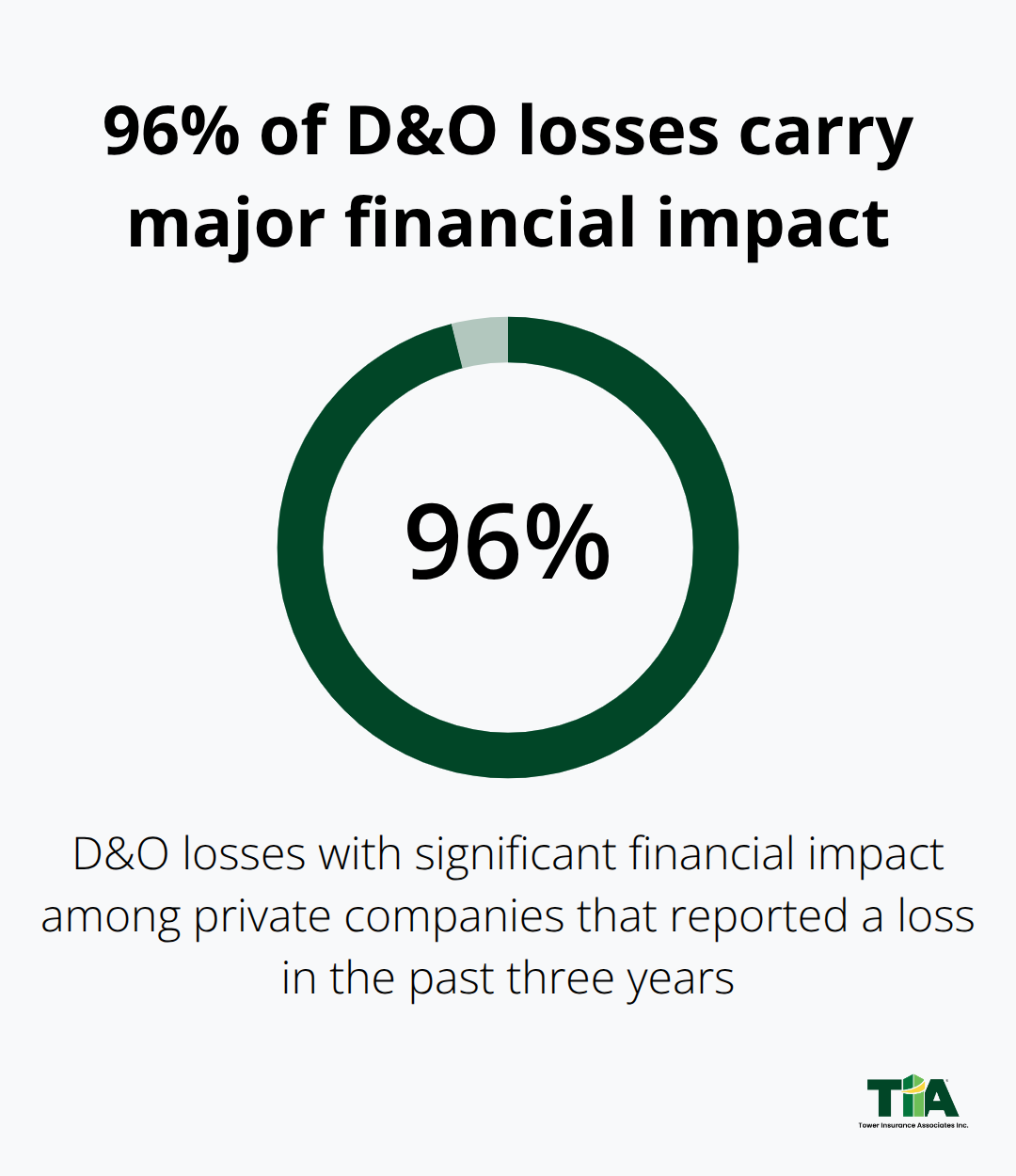
D&O insurance protects your directors and officers from personal financial devastation when sued in their individual capacity. The policy covers defense costs, settlements, and judgments arising from decisions they make while leading the company. Unlike general liability, which handles customer injuries or property damage, D&O addresses the governance and management decisions that trigger personal liability exposure for your leadership team. Over a quarter of private companies have experienced a D&O loss in the past three years, and 96% of those losses had significant financial impact, according to industry data. This means the risk isn’t theoretical-it’s affecting real companies right now.
When a shareholder alleges mismanagement, a regulator investigates your compliance practices, or an employee sues for wrongful termination tied to executive decisions, your directors and officers face personal liability. General liability simply doesn’t cover these scenarios because they stem from leadership actions, not operational accidents or product defects.
The Three-Part Structure That Actually Matters
D&O policies split protection into three distinct sides, and understanding which you need is critical. Side A covers individuals when the company cannot indemnify them, such as during insolvency or when bylaws restrict reimbursement. Side B reimburses the company for indemnifying directors and officers, signaling corporate commitment to protecting leadership.
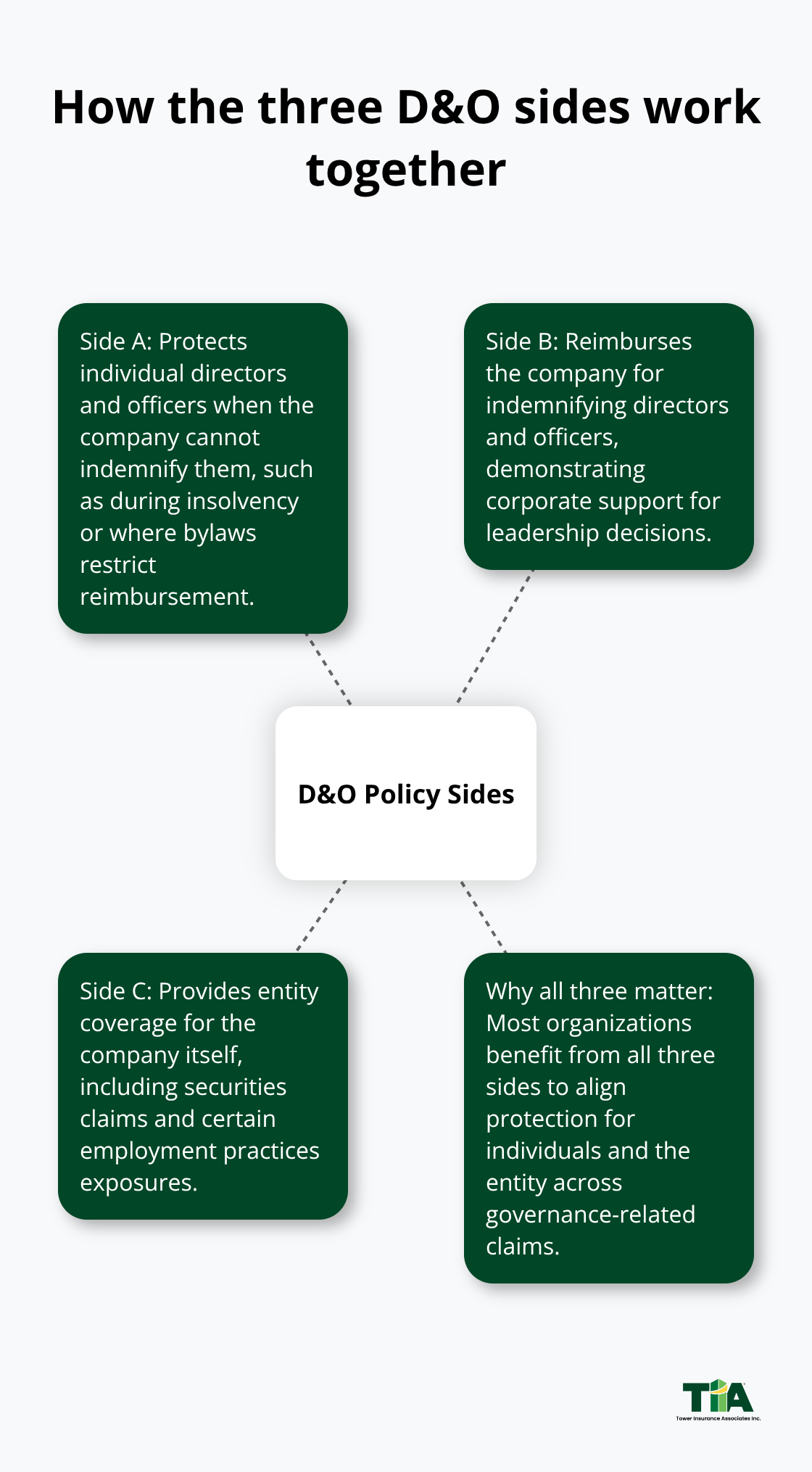
Side C provides entity coverage for the company itself, including securities claims and employment practices liability. Most organizations need all three sides, though the balance depends on your risk profile. A mid-size SaaS company’s D&O policy covered four directors’ defense costs exceeding $500,000 and facilitated a $1.2 million settlement, preventing personal bankruptcy for each director. Without proper Side A protection, directors drain their personal assets before any corporate reimbursement kicks in. Side C becomes especially important if your company faces shareholder litigation or regulatory action targeting the organization itself, not just individual leaders.
Why Executives Face Rising Legal Threats
Executives operate in a legal environment that has shifted dramatically. AI-focused securities actions surged between 2023 and 2025, with counts rising from 7 in 2023 to 14 in 2024 and 12 in the first half of 2025 (according to DLA Piper). This trend reflects boards facing governance claims over AI disclosure and risk management. Regulatory investigations remain persistent-SEC enforcement actions in 2025 totaled 313, the lowest in a decade, yet settlements still reached $808 million (according to Cornerstone Research). ESG-related litigation is rising, with boards increasingly sued over ESG disclosures and governance failures. Cybersecurity incidents trigger D&O claims when executives face blame for governance or disclosure failures related to data breaches. Without D&O coverage, your leadership team absorbs these costs personally, even if the company later reimburses them. Defense costs can reach hundreds of thousands before any settlement occurs, creating immediate cash flow problems and personal financial stress that no executive should face.
What Happens When Claims Hit Your Leadership
The financial impact of an uninsured D&O claim extends far beyond the settlement amount. Your directors and officers must pay their own legal defense costs upfront, which can total hundreds of thousands of dollars before any resolution. If the company cannot indemnify them (due to insolvency or restrictive bylaws), they face personal liability for the full judgment or settlement. This personal exposure creates a chilling effect on decision-making-executives become risk-averse and hesitant to make bold strategic moves that the company needs. Top talent also becomes harder to recruit and retain when board positions carry uninsured personal liability. D&O coverage removes this burden, allowing your leadership team to focus on running the business rather than protecting their personal assets. The policy covers not just settlements but also the defense costs that accumulate during investigations and litigation, protecting cash flow when it matters most.
How Coverage Gaps Leave You Exposed
Many executives believe their company’s general liability or employment practices policies cover D&O risks, but significant gaps exist. General liability excludes governance-related claims entirely. Employment practices liability covers some wrongful termination and discrimination claims but typically excludes shareholder litigation and regulatory investigations. Cyber liability covers data breach response but not the D&O claims that arise when executives face blame for governance failures related to the breach. These gaps mean your leadership team faces uninsured exposure across multiple risk categories. A comprehensive D&O policy fills these gaps and coordinates with your other coverages to prevent overlaps and uncovered scenarios. When you work with an independent agent who understands your industry and risk profile, they identify these gaps and recommend the right combination of coverages. This coordination ensures that when a claim hits, you have protection in place rather than discovering coverage doesn’t apply after the fact.
Common Claims and Real-World Scenarios
Employment Practices Claims Target Individual Executives
Employment practices claims represent one of the most common D&O exposures, yet many executives underestimate their personal liability. Wrongful termination, discrimination, and harassment allegations frequently name individual officers as defendants, not just the company. When an employee sues a VP of operations for discriminatory termination, that executive’s personal assets become a target even if the company indemnifies them later. Defense costs alone can exceed $250,000 before any settlement occurs. D&O coverage pays these costs immediately, preventing personal cash flow damage while the claim resolves.
Shareholder Litigation Creates Multimillion-Dollar Exposure
Shareholder litigation poses an even more serious threat because settlements routinely reach millions. A shareholder alleging that directors breached fiduciary duty through mismanagement or poor governance decisions can trigger securities claims that dwarf employment disputes. Between 2023 and 2025, AI-related securities actions jumped significantly, with DLA Piper documenting 7 cases in 2023, 14 in 2024, and 12 in the first half of 2025. This surge reflects boards facing claims over AI disclosure obligations and governance failures. Without Side A and Side C coverage, directors personally defend these claims and absorb losses when the company cannot indemnify them.
Regulatory Investigations Drain Personal Resources Over Years
Regulatory investigations create a third category of real-world exposure that catches many executives unprepared. SEC enforcement actions totaled 313 in 2025, with settlements averaging over $2.5 million according to Cornerstone Research. When regulators investigate your compliance practices or financial reporting, they often name individual officers as defendants alongside the company. Defense costs for regulatory matters extend across years, not months, creating sustained personal financial pressure. ESG-related regulatory scrutiny intensifies, with boards sued over disclosure accuracy and governance of environmental and social risks. Cybersecurity governance failures also trigger D&O claims when regulators or plaintiffs argue that executives failed to implement adequate controls before a breach occurred.
Building Protection Against Multiple Threat Categories
These scenarios require D&O policies with adequate limits and no exclusions that carve out governance-related conduct. A comprehensive D&O program with proper Side B and Side C coverage handles corporate indemnification and entity protection, ensuring your company stands behind leadership while protecting individual directors from personal bankruptcy. The next section examines how to assess your organization’s specific risk profile and select coverage limits that actually match your exposure.
Matching Coverage Limits to Your Company’s Real Risk
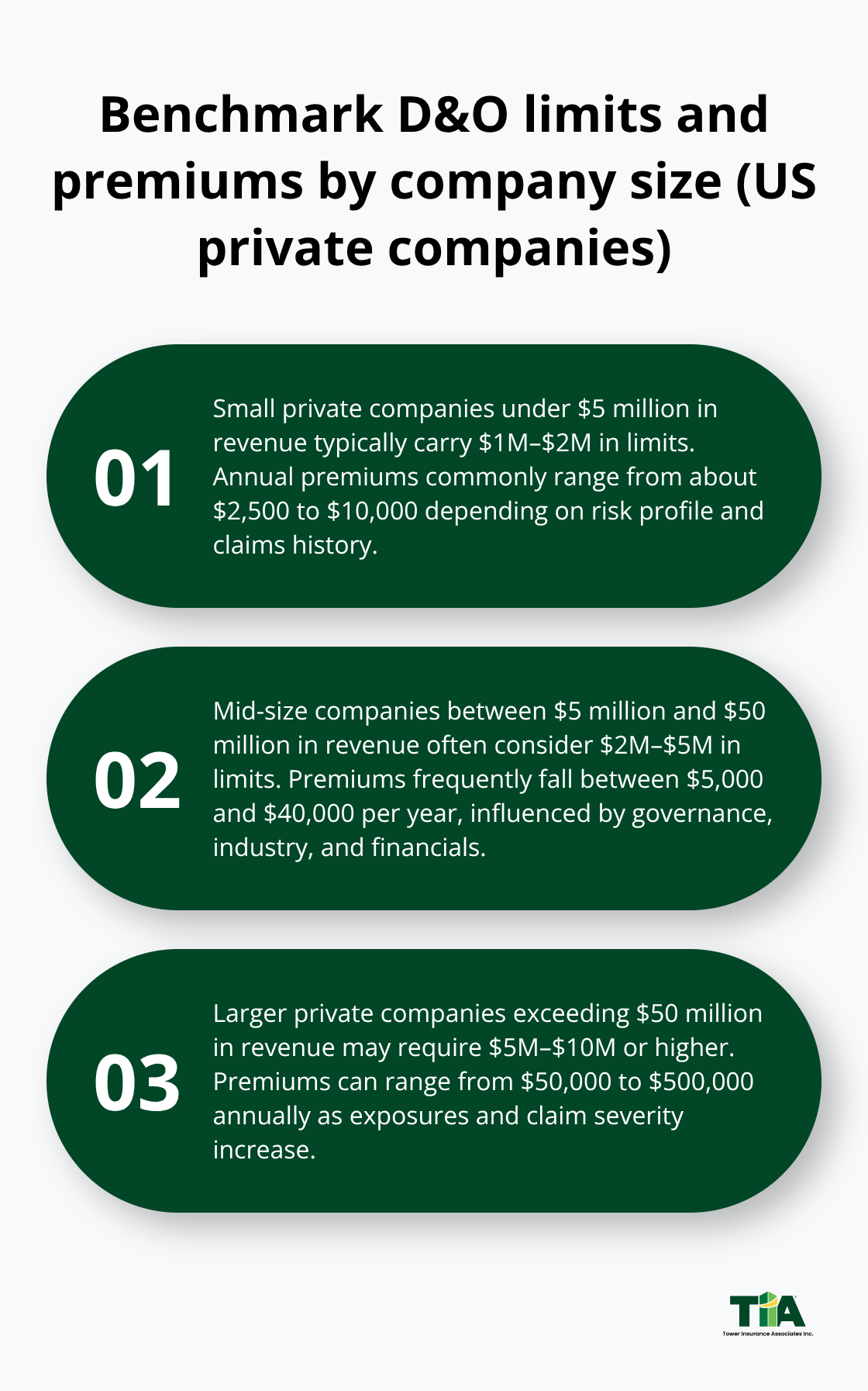
Selecting the right D&O policy starts with honest assessment of your company’s exposure, not industry averages or off-the-shelf limits. Small private companies under $5 million in revenue typically need $1 million to $2 million in coverage, which runs $2,500 to $10,000 annually according to market data. Mid-size companies between $5 million and $50 million in revenue should consider $2 million to $5 million in limits, costing $5,000 to $40,000 per year. Larger private companies exceeding $50 million in revenue often require $5 million to $10 million or higher, with premiums ranging from $50,000 to $500,000 annually.
However, these ranges miss the point entirely-your actual limits should reflect the specific threats your leadership team faces.
If your company operates in a regulated industry, handles sensitive customer data, or has made recent acquisitions, your exposure exceeds baseline expectations. If you’ve hired outside investors or plan to pursue growth capital, investors will demand D&O coverage with adequate limits before they commit funds. If your board includes independent directors or audit committee members, those individuals face heightened personal liability from shareholder claims and regulatory scrutiny. Start by asking what a realistic defense cost looks like in your industry and what settlement amounts shareholders or regulators have demanded from comparable companies. Defense costs alone in complex litigation reach $500,000 or more before any settlement occurs. Settlements in shareholder disputes involving governance failures routinely reach millions. Your coverage limits should exceed these realistic scenarios, not merely match industry minimums.
Three Sides Must Work Together, Not Independently
Side A protects directors and officers when the company cannot indemnify them, which matters most when insolvency threatens or restrictive bylaws prevent reimbursement. Side B reimburses the company for indemnification obligations to directors, signaling to your leadership team that the organization stands behind their decisions. Side C covers the company itself for entity-level claims, including securities litigation and employment practices liability. Many companies assume they need only Side A, believing that Side B and Side C add unnecessary cost. This assumption costs them dearly when claims hit.
A well-structured program includes all three sides with adequate limits on each rather than stacking all limits on Side A alone. Your deductible or retention amount also varies by side-Side A typically carries no deductible to maximize protection for individuals, while Side B and Side C usually include retentions that the company absorbs. Higher deductibles reduce premiums but shift more risk to your company during claims. If your company has strong cash reserves and can absorb a $50,000 or $100,000 retention without operational impact, higher deductibles make financial sense. If cash flow is tight or unpredictable, lower deductibles protect your liquidity when a claim arrives.
Most importantly, verify that your policy includes no exclusions that carve out the governance-related conduct most likely to trigger claims at your company. Prior acts exclusions block coverage for conduct occurring before the policy inception date, which creates exposure during ownership transitions or management changes. Insured-versus-insured exclusions prevent coverage when directors sue each other, leaving those individuals unprotected in internal disputes. Confirm with your agent that conduct exclusions can be softened with endorsements allowing coverage through final non-appealable adjudication, preserving defense costs across appeals when executives face extended litigation.
Identify Coverage Gaps Before Claims Arrive
Rate shopping typically delivers the worst D&O policies because the cheapest option often excludes critical coverage or includes inadequate limits. An independent agent representing multiple carriers can benchmark your coverage against similar companies in your industry, identifying gaps that rate-focused brokers overlook. A competent agent asks about your board composition, recent business changes, regulatory environment, and planned growth initiatives-not just company revenue and claims history.
If your company plans an acquisition, merger, or IPO within the next three years, your D&O program needs tail coverage or an extended reporting period endorsement to protect against claims arising from conduct during the policy period after the policy ends. Without tail coverage, your leadership team loses protection for decisions made today once the policy expires, creating uninsurable exposure during transitions. If you operate in a regulated industry facing increased regulatory scrutiny, limited regulatory defense add-ons provide specialized coverage for enforcement-related defense costs beyond standard policy limits. If cybersecurity governance has become a board-level concern following industry breaches or regulatory guidance, verify that your policy covers D&O claims arising from cybersecurity governance failures and coordinate coverage with your cyber liability policy to avoid gaps.
An agent who understands your industry knows which endorsements prevent gaps and which add unnecessary cost for risks you don’t face. They also understand claims handling quality, which matters as much as coverage terms when a claim arrives. Meet with potential agents and ask about their claims team’s settlement authority and typical resolution timelines. An insurer that can settle large claims quickly without bureaucratic delays protects your executives’ financial and emotional well-being during stressful litigation.
Final Thoughts
D&O coverage for executives protects your leadership team from personal financial devastation when governance claims arrive. Over a quarter of private companies experienced losses in the past three years, and 96% of those losses had significant financial impact-this risk affects real companies operating today. Your coverage must include all three sides (A, B, and C) with limits matching your actual exposure, not industry minimums, and you need to identify gaps in general liability, employment practices, and cyber policies that leave your executives unprotected.
Start your coverage review immediately by gathering your current D&O policy and asking your agent whether adequate limits exist for realistic defense costs and settlements in your industry. Verify that all three sides appear in your policy with appropriate retentions and deductibles for your company’s financial position, and confirm whether prior acts exclusions apply to your situation. Many executives operate under policies purchased years ago that no longer match their company’s current risk profile, board composition, or regulatory environment.
We at Tower Insurance Associates help executives and their companies understand what D&O protection actually covers and why it matters for your specific situation. As an independent insurance agency in Culver City, California representing multiple top-rated carriers, we provide personalized service and competitive pricing tailored to your risk profile. Contact Tower Insurance Associates to discuss your D&O coverage with an agent who understands your industry and can benchmark your protection against comparable companies.
Disclaimer: This blog post is for general informational purposes only and does not represent actual coverage, policy terms, or legal requirements. Insurance details vary by individual and jurisdiction. Please consult a licensed insurance professional for advice specific to your situation.