
California small business cyber attacks are accelerating. Small businesses in California face more sophisticated threats than ever, with attackers increasingly targeting companies with fewer defenses.
At Tower Insurance Associates, Inc., we’ve seen firsthand how quickly a breach can disrupt operations and drain resources. This guide walks you through real-world protection strategies that actually work.
The Rising Cyber Threat Landscape for California Small Businesses
How Often California Small Businesses Get Attacked
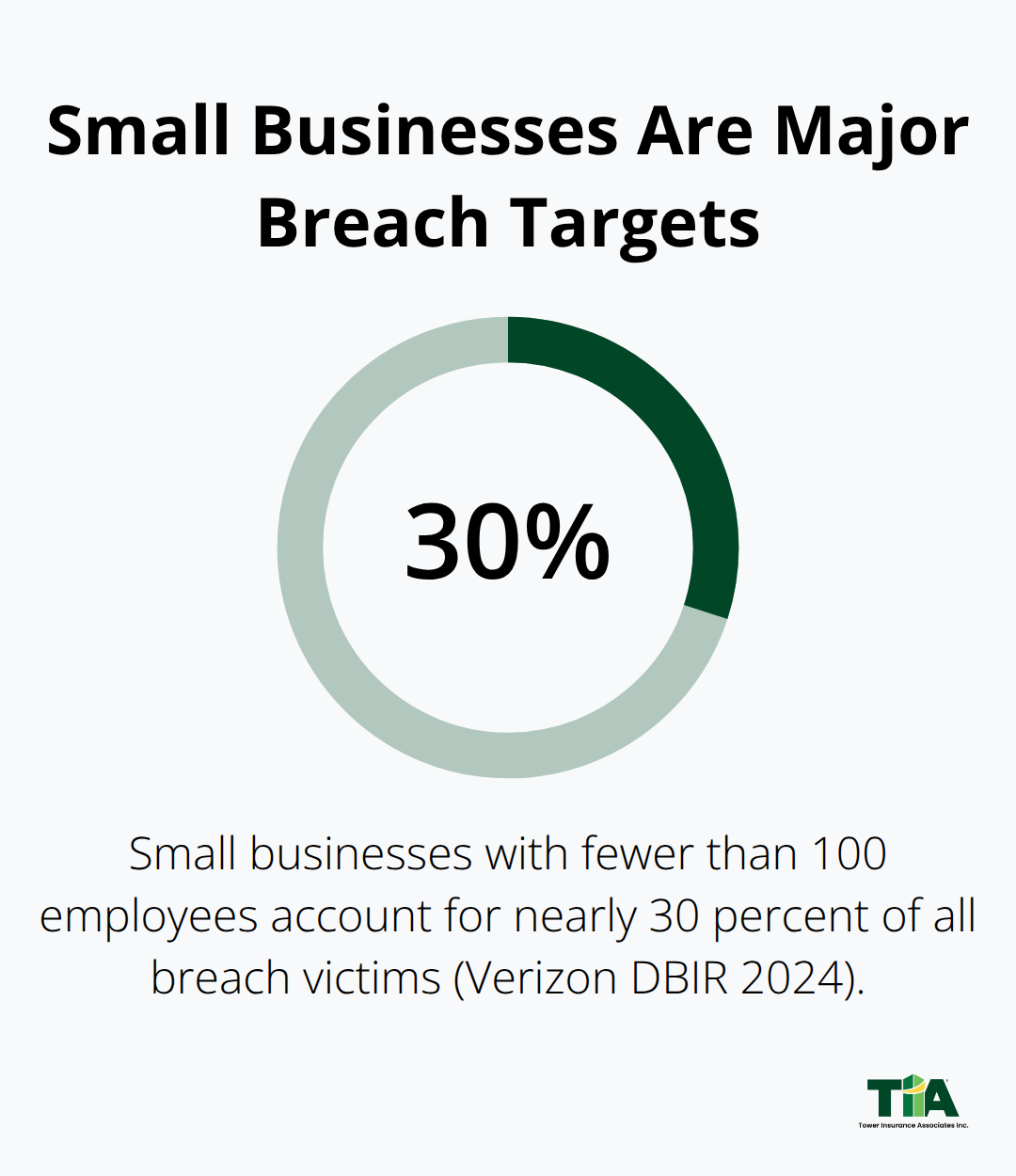
California small businesses face a threat landscape that most owners underestimate. According to the 2024 Verizon Data Breach Investigations Report, small businesses with fewer than 100 employees account for nearly 30 percent of all breach victims, yet they operate without dedicated security teams. In California specifically, ransomware attacks against small businesses increased year-over-year in 2024. The Federal Bureau of Investigation reports that California consistently ranks in the top three states for cybercrime losses.
Time works against California small businesses in breach situations. Most California small businesses take considerable time to discover a breach, meaning attackers maintain extended access to sensitive data before anyone identifies the problem.
The Attack Types Targeting California Businesses
Ransomware dominates the attack vector landscape for California small businesses. Phishing emails serve as the entry point in successful attacks, because employees remain an accessible target. Business email compromise, where attackers impersonate executives to authorize fraudulent wire transfers, has impacted California businesses.
Remote access vulnerabilities exploded after 2020 when California businesses rapidly shifted to hybrid work models without proper security infrastructure. Supply chain attacks have become increasingly common, with hackers targeting small vendors to gain access to larger clients.
The Financial Toll of Breaches
The financial toll compounds quickly for California small businesses. Data recovery and regulatory compliance represent significant expenses for most small businesses. Operational disruption often proves more damaging than the direct financial losses, with breached businesses reporting revenue loss during recovery periods.
These attack patterns and financial consequences make it clear that California small businesses need more than hope. Understanding what protections actually work separates businesses that recover quickly from those that face months of operational chaos.
How to Actually Stop Cyber Attacks Before They Start
Multi-Factor Authentication Stops Account Takeovers
California small businesses fail at cyber defense because they treat security like a checkbox rather than a continuous practice. Start with multi-factor authentication on every account that accesses sensitive data, since the 2024 Verizon Data Breach Investigations Report found that weak or stolen credentials remain the top attack vector. Require MFA for email, financial systems, customer databases, and administrative tools immediately. This single step blocks approximately 99.9 percent of account takeovers according to Microsoft security research. Your employees will resist initially, but the friction disappears within two weeks.
Patch Management Closes Known Vulnerabilities
Establish a patch management schedule that applies updates within 30 days of release, not whenever someone remembers. Unpatched systems created the opening for the MOVEit vulnerability that compromised California businesses in 2023. Automate patches where possible through your IT provider or managed service provider rather than relying on manual processes. The cost of a managed service provider (running approximately $100 to $300 monthly per device) remains trivial compared to ransomware cleanup expenses that average $200,000 for small businesses.
Targeted Employee Training Reduces Phishing Success
Employee training separates businesses that survive attacks from those that collapse under them. Phishing emails remain the entry point in most California breaches, yet generic security training fails because employees forget it within weeks. Instead, conduct monthly phishing simulations using tools like Proofpoint or KnowBe4 that send fake phishing emails to your team and track who clicks suspicious links. Employees who fail the test complete focused training on recognizing social engineering tactics specific to your industry.
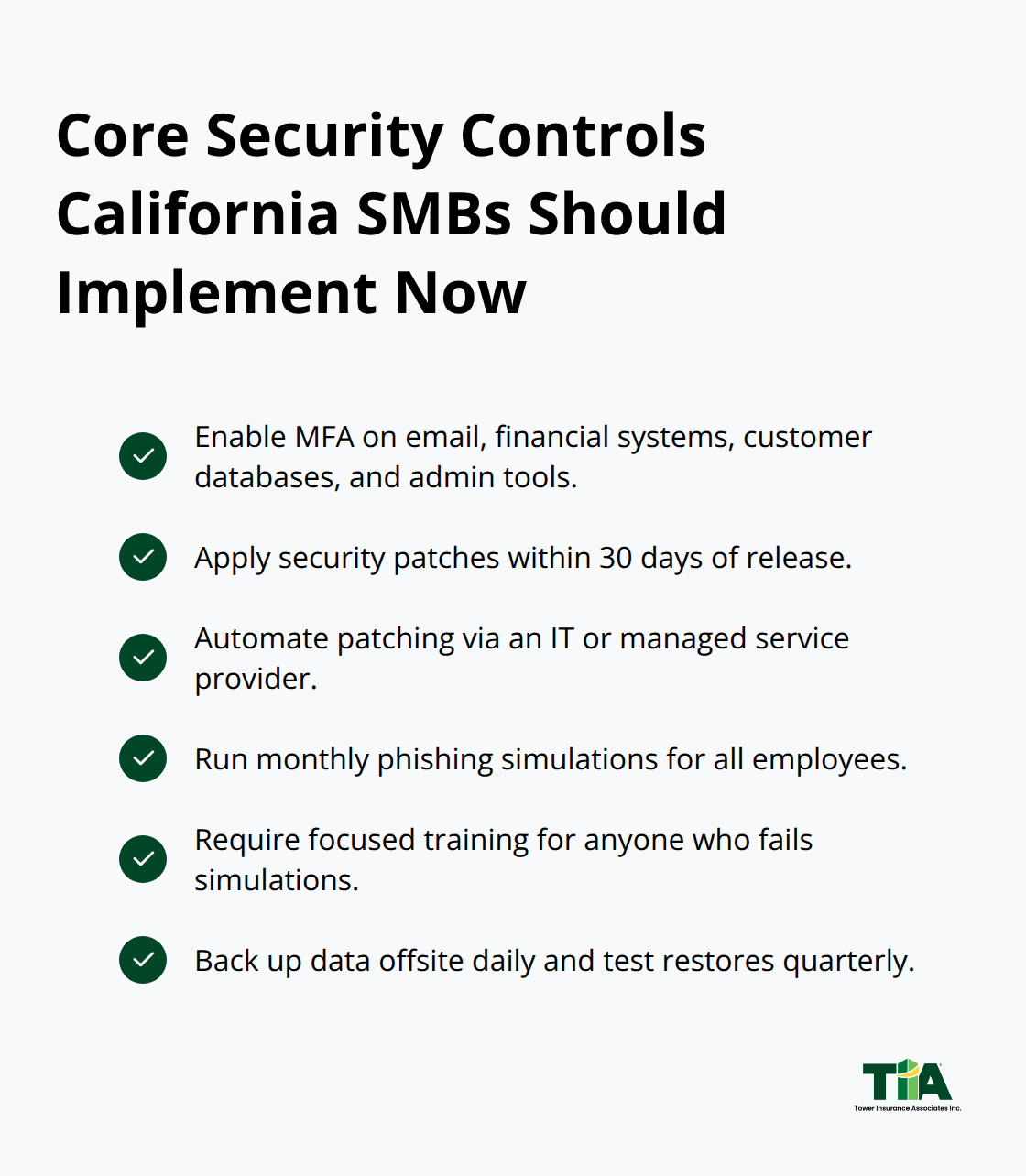
This targeted approach costs approximately $3 to $8 per employee monthly and measurably reduces click rates.
Verified Backups Protect Against Total Data Loss
Establish a data backup and disaster recovery plan that backs up critical systems daily to an offsite location separate from your main network. Test your recovery process quarterly by actually restoring data to verify it works when you need it. Many California businesses discovered their backups were corrupted only after an attack, leaving them with no recovery option. MFA, patching discipline, behavioral training, and verified backups create genuine resilience that makes your business an unattractive target for attackers who prefer easier prey. However, technical controls alone cannot protect against every threat-your business also needs financial protection through proper cyber liability coverage.
Cyber Insurance and Risk Management Strategy
Why Technical Controls Leave Financial Gaps
Technical controls stop many attacks, but they stop none of them completely. California small businesses that invest in MFA, patching, training, and backups still face financial devastation when a breach occurs because the operational costs of recovery extend far beyond what most owners anticipate. Cyber liability insurance fills this gap by covering the expenses that security measures alone cannot prevent.
The average cost to recover from a ransomware attack reaches $200,000 for small businesses according to Verizon’s 2024 report, yet most California small businesses carry zero cyber coverage. This gap between attack frequency and insurance adoption creates a dangerous situation where a single breach can force a business to close permanently.
What Cyber Policies Actually Cover
Cyber liability policies cover forensic investigation costs, which typically run $15,000 to $50,000 to determine breach scope and cause. Notification expenses to affected customers average $3 to $14 per person based on data from the Ponemon Institute, which means notifying 1,000 customers costs $3,000 to $14,000 in addition to investigation fees.
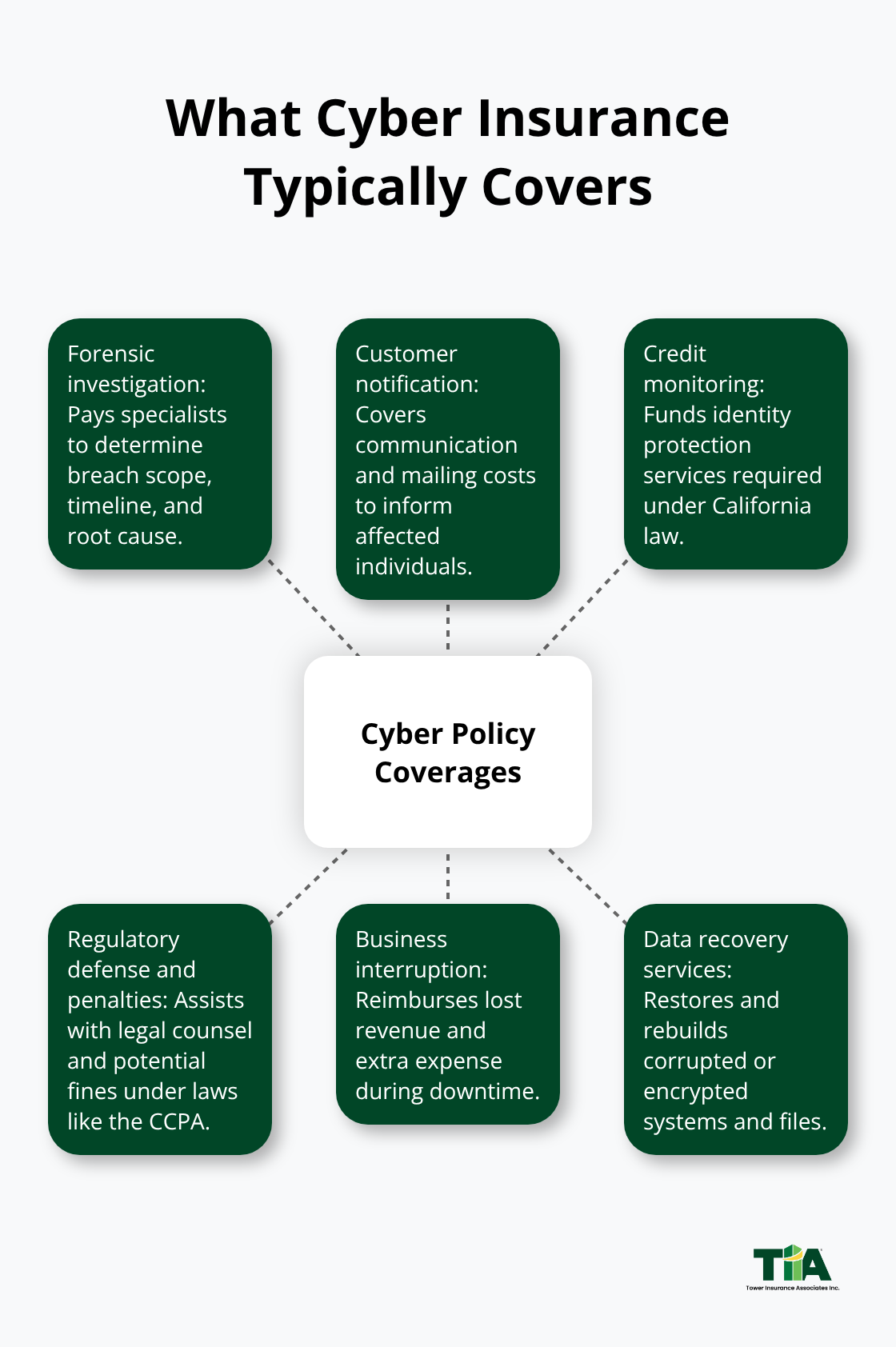
Credit monitoring services for affected parties, required by California’s data breach notification law, add another layer of expense that most business owners never budget for. Regulatory fines under California’s Consumer Privacy Act can reach $7,500 per violation, with violations sometimes numbering in the hundreds or thousands depending on breach scope.
Business interruption coverage within a cyber policy reimburses lost revenue during recovery periods, protecting cash flow when operations grind to a halt. Your policy should explicitly cover forensic investigation, notification costs, credit monitoring, regulatory defense and penalties, business interruption, and data recovery services without extensive exclusions that render coverage worthless when you need it.
Matching Coverage Limits to Your Actual Exposure
Selecting adequate coverage requires honest assessment of your actual data exposure and operational vulnerability rather than purchasing whatever limit seems reasonable. A California small business handling 5,000 customer records needs substantially different coverage than one handling 50,000 records, yet many owners choose policy limits based on price rather than exposure.
Coverage limits for a California small business should start at $500,000 minimum and extend to $2,000,000 if you process payment cards or maintain significant customer data, according to guidance from the National Cyber Security Alliance. Many policies exclude coverage for attacks resulting from known unpatched vulnerabilities, which means your patch management discipline directly impacts whether claims get paid.
Critical Policy Exclusions to Watch
Ransomware coverage specifically matters for California small businesses since ransomware attacks increased substantially in 2024 and many older policies exclude this threat entirely. Your existing general liability and commercial property policies typically exclude cyber-related losses completely, leaving you with no coverage despite assuming you have protection.
Coverage cost for a California small business runs approximately $1,500 to $5,000 annually depending on industry, employee count, and your security controls, making cyber insurance one of the most cost-effective risk management investments available. An independent insurance agency representing multiple carriers can help you identify policies that actually match your business needs rather than leaving dangerous gaps in your protection.
Final Thoughts
Your California small business cyber resilience depends on three interconnected layers working together. Technical controls like multi-factor authentication, patch management, employee training, and verified backups form your first line of defense by making your business a harder target for attackers. These measures stop most attacks before they cause damage, but they cannot stop every threat.
Cyber liability insurance fills the financial gaps that technical controls leave behind. A breach that costs $200,000 to recover from becomes catastrophic without proper coverage, which is why your policy must cover forensic investigation, customer notification, credit monitoring, regulatory fines, business interruption, and data recovery services without exclusions that eliminate protection when you need it most. Your coverage limits should start at $500,000 minimum and extend to $2,000,000 if you process payment cards or maintain significant customer data.
Start immediately by implementing multi-factor authentication across all sensitive systems, establishing a patch management schedule with 30-day update windows, and conducting monthly phishing simulations with your team. Then contact an independent insurance agency that represents multiple carriers to evaluate your cyber liability coverage gaps. Tower Insurance Associates, Inc. has helped California small businesses since 1961 by providing personalized guidance on coverage that actually protects your operations-visit our site to discuss your specific cyber insurance needs with our team and get a quote that reflects your actual exposure.
Disclaimer: This blog post is for general informational purposes only and does not represent actual coverage, policy terms, or legal requirements. Insurance details vary by individual and jurisdiction. Please consult a licensed insurance professional for advice specific to your situation.