

California businesses face a growing wave of cyber attacks that can cripple operations and drain finances. Ransomware, phishing, and vendor breaches are no longer rare incidents-they’re becoming routine threats that demand real protection.
Business cyber insurance in California covers the costs most companies overlook: breach notifications, lost income during downtime, and legal fees. We at Tower Insurance Associates, Inc. help businesses understand what coverage actually matters and how to choose policies that fit their real risks.
What Threats Actually Hit California Businesses
Ransomware and Phishing: The Primary Attack Chain
Ransomware has become the dominant attack vector for California companies. Phishing serves as the entry point for most ransomware deployments-attackers send phishing emails, smishing via text, and spearphishing targeting specific employees to gain initial access. Once inside your network, they encrypt critical files and demand payment. Attackers often calibrate ransom amounts to match your cyber insurance policy limits, a tactic documented by Coalition Incident Response. This means attackers gain visibility into your coverage details and use them as negotiation leverage. A North American law firm paid nearly $900,000 after attackers referenced specific policy limits to pressure settlement.
The financial impact extends far beyond ransom payments. Notification costs alone run $200–$300 per record, and forensic investigations consume $50,000–$100,000 upfront. For a company with 5,000 customer records exposed, notification costs hit $1 million before recovery even begins.
Insider Threats and Vendor Vulnerabilities
Third-party vendor breaches create exposure you cannot control directly. Your business becomes liable when a vendor storing your data suffers a breach-customers hold you accountable regardless of where the actual failure occurred. The Cybersecurity Insiders 2024 Insider Threat Report found that 83% of organizations reported at least one insider attack in the past year, with incidents among firms facing 11–20 attacks jumping fivefold year over year.
This escalation reflects the reality that remote work, cloud adoption, and complex IT environments have widened the attack surface. Inadequate security measures and outdated protocols create gaps that expose your data to both external attackers and malicious insiders. The most common direct remediation costs after insider threats range from $100,000–$499,000, with 21% of affected companies facing $1–2 million in losses.
Why Standard Coverage Falls Short
These figures underscore why cyber insurance must cover breach response, notification, recovery costs, and legal defense-not just ransom payments. Understanding what your policy actually covers becomes the foundation for choosing protection that matches your real exposure. The next section walks through the specific coverages that matter most for California businesses.
What Your Cyber Insurance Policy Actually Pays For
Breach Response and Notification Expenses
Cyber insurance covers breach response and notification expenses that standard business policies ignore entirely. When customer data leaks, forensic investigations cost $50,000–$100,000 upfront, and notification expenses run $200–$300 per exposed record. A company with 10,000 affected records pays $2–3 million in notification alone before any ransom or recovery costs appear. Your policy covers these response expenses, credit monitoring services for affected customers, and public relations support to manage reputational damage.
Business Interruption and Lost Income
Ransomware or data destruction forces your operations offline and stops revenue while you still pay salaries and fixed costs. Cyber policies reimburse that lost income during the recovery period, a protection that often saves companies more money than the ransom itself. This coverage addresses the financial gap between when an attack hits and when your systems come back online.
Legal Fees and Regulatory Penalties
Legal fees and regulatory fines represent the fastest-growing expense after a breach. California’s strict privacy laws, combined with federal regulations like HIPAA for healthcare providers, create fines that standard cyber policies frequently exclude. You need explicit coverage for regulatory penalties and legal defense costs when customers file lawsuits or regulators investigate your data handling practices.
Understanding Policy Limits and Costs
The specific limits matter enormously. A $1 million policy with a $2,500 deductible sounds reasonable until a breach hits and consumes the entire limit on forensics, notification, and legal defense before you even address recovery costs. California government contracts increasingly demand $5 million in combined cyber and Technology Errors & Omissions coverage to address ransomware and data privacy risk, a standard that reflects real breach costs.
The average monthly cost for cyber insurance runs $134 for small businesses, or roughly $1,609 annually, though premiums range from $400 to $8,000 depending on your industry and data exposure. IT and technology businesses average $148 per month due to higher risk, while finance-related companies average $58 monthly. Bundling cyber coverage with your general liability or property policies often yields 10–15% savings compared to standalone coverage.
Reviewing Your Policy Declarations
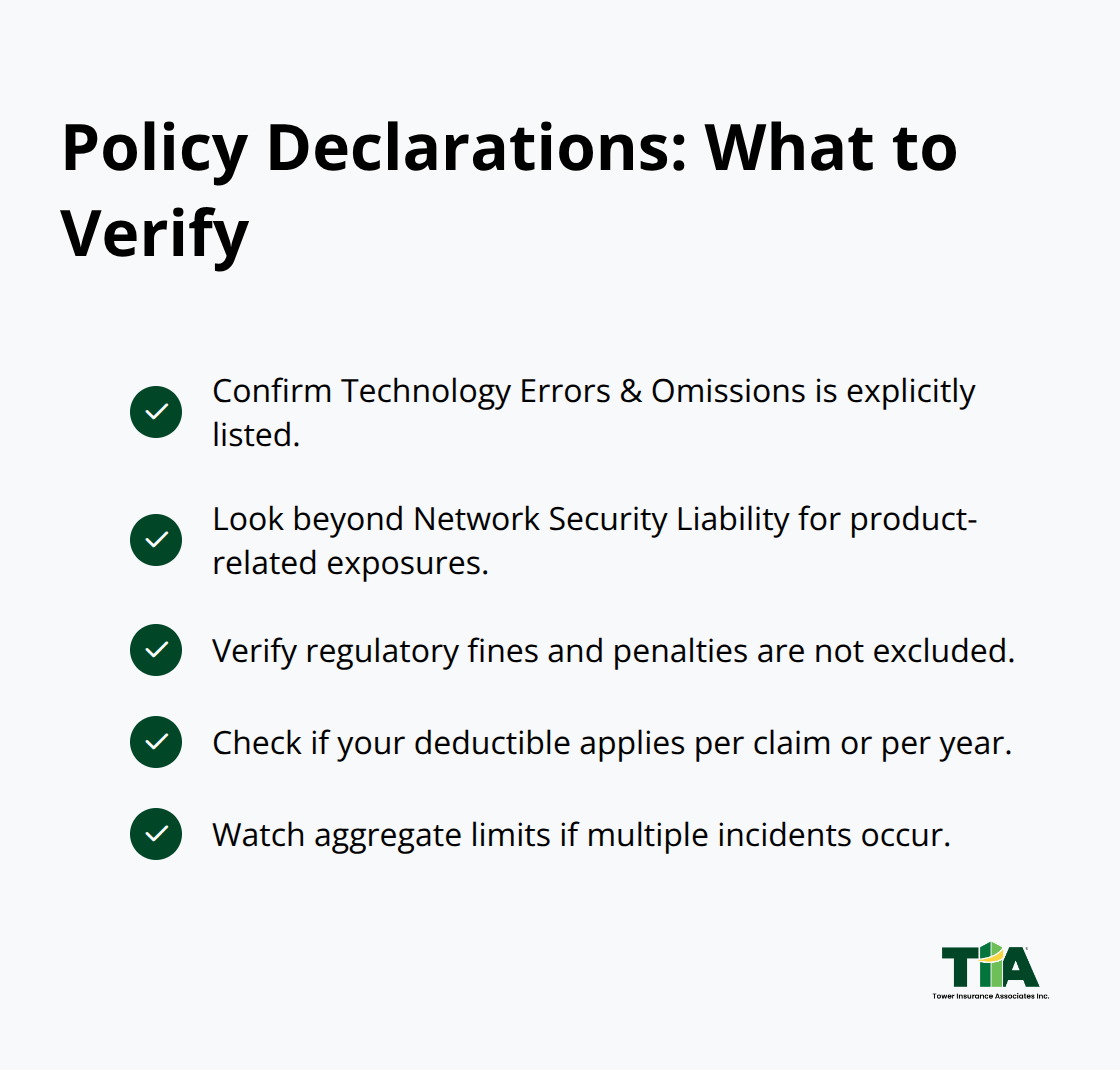
Review your policy declarations carefully to confirm Technology Errors & Omissions coverage appears explicitly, not just Network Security Liability language that may exclude product-related failures. Check whether regulatory fines and penalties carry exclusions, and verify whether your deductible applies per claim or per year, since multiple incidents can exhaust aggregate limits faster than you expect. These details determine whether your policy actually protects your business when a breach occurs.
Picking the Right Policy for Your Actual Risk
Measure Your Specific Exposure, Not Industry Averages
Your industry matters far less than the data you handle and the systems attackers target. A California manufacturer with 500 employees handling customer payment information faces different risk than a software company with 50 staff processing healthcare records. IT and technology businesses pay $148 monthly for cyber insurance on average, while finance-related companies average $58 monthly, but those figures only matter if they match your operational reality. Calculate how many customer records you store, whether you process payment data or health information, how many remote workers access your systems, and whether vendors have access to your network. A company storing Social Security numbers and medical histories needs higher limits than one handling only email addresses.
Request Quotes That Match Your Risk Profile
Request quotes from multiple carriers and ask each underwriter what specific risk factors drive their premium calculation. Some carriers weight employee training heavily, others focus on backup and recovery procedures, and a few scrutinize your incident response plan. The carrier that asks detailed questions about your actual security posture will likely underwrite more accurately than one quoting based on employee count alone. This approach reveals which insurers understand your business and which ones apply generic formulas.
Demand Explicit Coverage for Real Costs
Verify that your policy covers breach notification costs ranging from $128 to $234 per record, forensic investigation costs of $50,000–$100,000, regulatory fines under California privacy laws, and business interruption losses during recovery. A $1 million per-claim limit with a $3 million annual aggregate sounds adequate until a single breach consumes $2 million on forensics and notification, leaving only $1 million for legal defense and recovery costs. Policy limits and deductibles matter more in California than in other regions because your regulatory obligations are steeper.
Review Policy Details That Determine Protection
Check whether your deductible applies per claim or annually, since multiple incidents in one year can exceed your aggregate limit faster than expected. Review exclusions carefully for unencrypted devices, failure to patch vulnerabilities, and whether regulatory penalties carry sub-limits that fall short of actual fines. An AM Best rating of A- VII or better ensures your carrier can actually pay claims, a detail that matters when you file a $500,000 breach claim and discover your insurer lacks reserves. Bundling cyber coverage with general liability or property policies typically saves 10–15% compared to standalone policies, making it worth requesting package quotes from the same carrier.
Final Thoughts
Cyber threats in California strike real businesses every day, and the financial damage extends far beyond ransom demands. Notification costs, forensic investigations, legal fees, and regulatory fines accumulate quickly, which is why business cyber insurance California has become essential rather than optional. The protection you need covers breach response expenses, business interruption losses, and regulatory penalties that standard policies exclude entirely.
Your specific risk profile determines the right limits for your business, not industry averages or competitor policies. Start by calculating your actual exposure: count how many customer records you store, identify which systems attackers target most, and assess your current security measures. Request quotes from multiple carriers and ask each underwriter what specific risk factors drive their premium, since an insurer that asks detailed questions about your incident response plan understands your business better than one quoting based on employee count alone.
We at Tower Insurance Associates, Inc. help California businesses find cyber coverage that matches their real risks and budgets. Contact Tower Insurance Associates to discuss your cyber insurance needs and receive a quote that reflects your actual exposure.
Disclaimer: This blog post is for general informational purposes only and does not represent actual coverage, policy terms, or legal requirements. Insurance details vary by individual and jurisdiction. Please consult a licensed insurance professional for advice specific to your situation.