

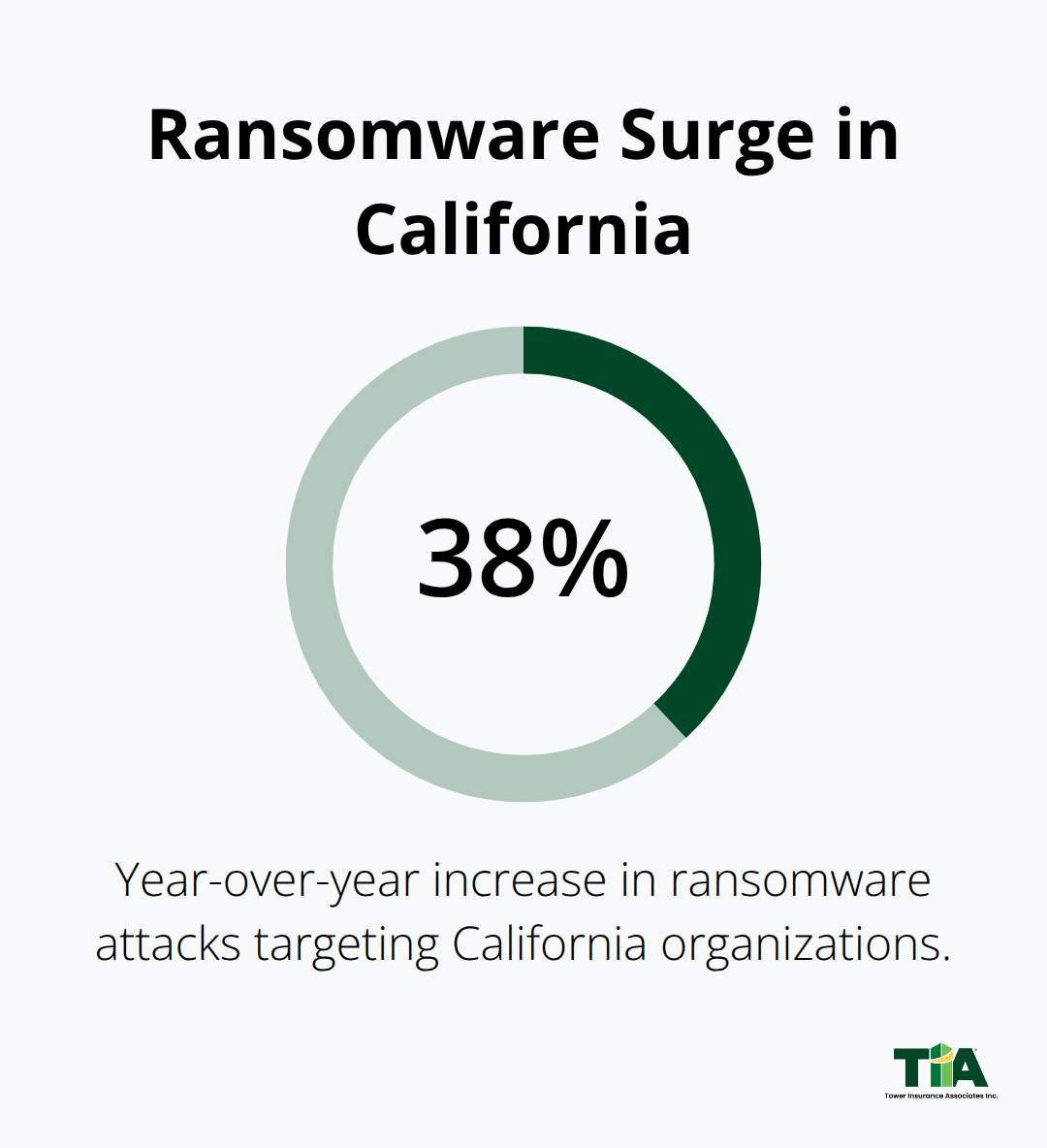
Cyber attacks on California businesses are accelerating, with ransomware incidents up 38% year-over-year according to recent threat reports. Most small and mid-sized companies lack adequate protection against data breaches, notification costs, and regulatory fines.
At Tower Insurance Associates, Inc., we’ve helped countless California business owners understand their cyber liability insurance options. This guide walks you through the coverage components that matter most and how to select the right California business cyber policy for your specific needs.
What Cyber Liability Insurance Actually Covers
The Real Cost of Data Breaches
Cyber liability insurance protects your California business from the financial fallout of data breaches, ransomware attacks, and other digital threats. The coverage pays for breach notification costs, which run between $3.86 and $4.45 per compromised record according to IBM’s 2024 Data Breach Report, plus forensic investigation, credit monitoring services for affected customers, legal defense, regulatory fines, and business income loss during system downtime. Unlike general liability or property insurance, cyber policies address the specific risks of operating in a digital environment where a single attack can cost your business hundreds of thousands of dollars.
California’s data breach notification law requires companies to notify affected individuals within 30 calendar days of discovery or notification of the breach, and those notification expenses alone can bankrupt unprepared small businesses. A single breach affecting 5,000 customers translates to $19,300 to $22,250 in notification costs before you factor in forensic investigation or regulatory penalties. Most business owners underestimate these expenses until they face them directly.
Why Your Business Size Doesn’t Protect You
The threat landscape in California is intensifying across all business sizes. Ransomware attacks against California organizations increased 38% year-over-year, and healthcare providers, financial services firms, and manufacturing businesses face the highest targeting rates. Small and mid-sized businesses are actually preferred targets because they typically have weaker security infrastructure but still hold valuable customer data.
The average cost to recover from a ransomware attack reaches $2.6 million when you factor in ransom payments, system restoration, downtime, and notification obligations. Retail businesses, professional services firms, and technology companies operating in California face particularly acute risk due to the volume of customer payment information and personal data they handle. Your industry matters enormously when assessing cyber risk, and a construction company faces different exposures than a medical practice or accounting firm.
Moving Forward with Protection
Waiting until after a breach occurs to think about cyber insurance guarantees you’ll face uninsured losses that could threaten your business survival. The next section walks you through the specific coverage components that matter most for California businesses, so you can identify which protections align with your actual risk profile.
Key Coverage Components of Cyber Liability Policies
What Breach Response Coverage Actually Protects
Cyber liability policies contain multiple moving parts, and understanding what each component covers prevents gaps from appearing after a breach occurs. Notification costs alone average $3.86 to $4.45 per affected record according to IBM’s 2024 Data Breach Report, but that’s just the beginning. A breach affecting 10,000 California customers generates $38,600 to $44,500 in notification expenses before forensic investigation, legal fees, or regulatory penalties enter the picture.
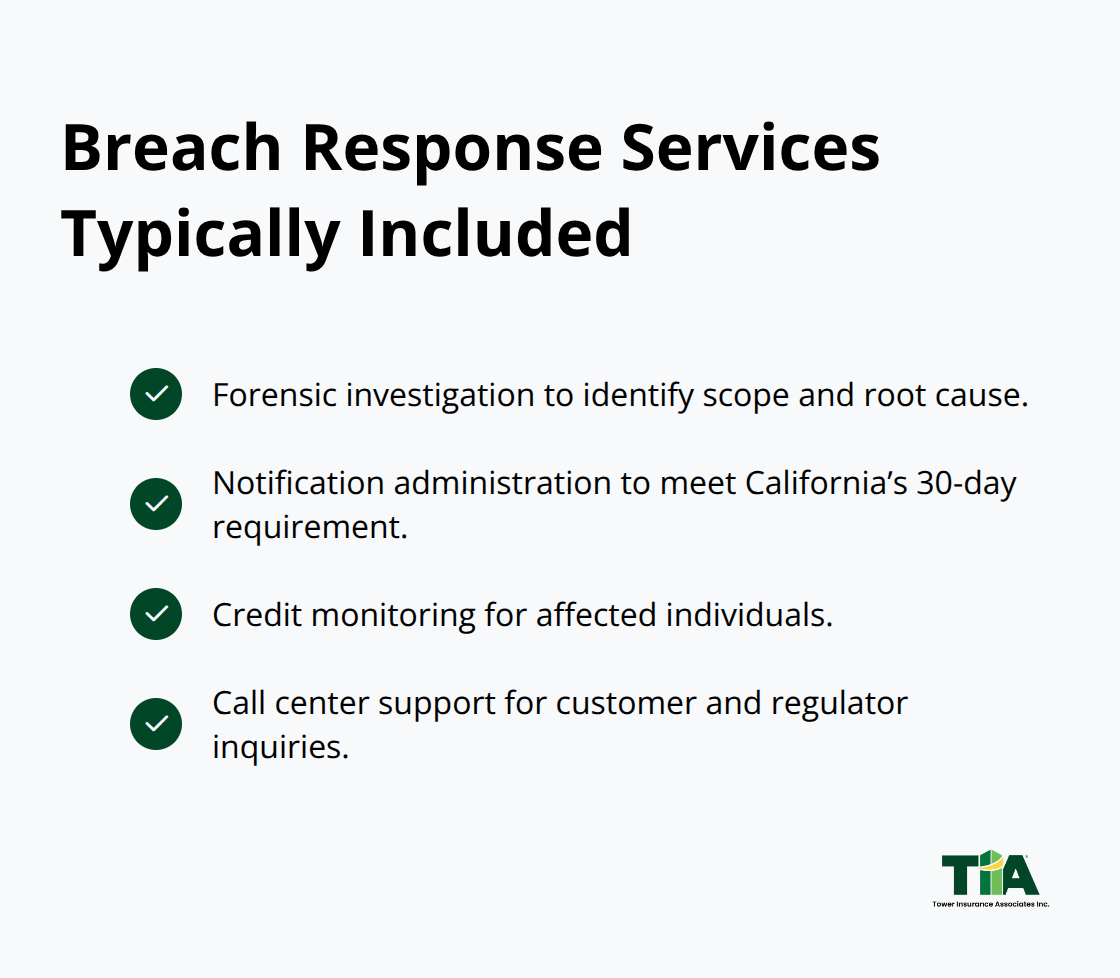
Your policy should cover breach response services including forensic investigators, notification administration, credit monitoring for affected individuals, and call center support. These services activate immediately after you detect a breach, and they determine how quickly you notify customers and regulators. The faster you respond, the lower your liability exposure becomes under California’s 30-day notification requirement.
Business Interruption Protects Your Revenue Stream
Business interruption coverage protects your income during system downtime, which averages 21 days for ransomware incidents according to Coveware data. This component reimburses lost revenue and covers operating expenses that continue while your systems remain offline. A manufacturing company losing production for three weeks faces massive income loss, and this coverage prevents that loss from destroying your cash flow.
Without this protection, you absorb the full financial impact of downtime yourself. Most business owners underestimate how quickly revenue evaporates when systems go dark, especially if you operate on thin margins.
Legal Defense and Regulatory Fines Coverage
California regulators impose substantial fines for delayed breach notification or inadequate security measures, with penalties reaching $7,500 per violation under state privacy laws. Legal defense coverage pays for attorneys experienced in data breach litigation and regulatory investigations, which costs $500 to $800 per hour in California markets. This coverage becomes essential the moment regulators launch an investigation into your breach response.
Attorneys who specialize in California data privacy law command premium rates, and regulatory investigations typically span several months. Without this coverage, you pay these costs directly from your operating budget.
Third-Party Liability and Extortion Protection
Third-party coverage applies when other parties take legal or regulatory action against your business after a breach. This coverage is non-negotiable for any business handling customer payment information or personal data. Customers whose information you failed to protect can sue your company for damages, and these lawsuits regularly exceed $100,000 in California.
Ransomware attackers frequently demand payment to prevent data sale or publication, and this coverage addresses those extortion attempts. Many California business owners focus solely on breach notification costs and ignore the other financial exposures that follow.
Evaluating Your Total Coverage Needs
A manufacturing company hit by ransomware faces ransom demands, system restoration costs, forensic investigation, customer notification, regulatory investigation, and potential lawsuits from customers whose data was exposed. Without comprehensive coverage, you absorb losses that regularly exceed $500,000 for mid-sized businesses. The next chapter explains how to evaluate whether your coverage limits match your actual exposure and how to compare policies across carriers based on your specific industry and customer data volume.
How to Select the Right Cyber Liability Policy for Your California Business
Calculate Your Minimum Coverage Limits
Your industry determines which coverage limits actually matter, and this is where most California business owners make costly mistakes. A healthcare practice handling thousands of patient records needs vastly different limits than a consulting firm with minimal customer data exposure. Start by counting exactly how many customer records your business maintains, then multiply that number by the per-record notification cost from IBM’s 2026 Data Breach Report. A dental practice with 8,000 patient files faces notification costs before adding forensic investigation or regulatory penalties.
This calculation should drive your minimum coverage limit. Most California businesses should carry at least $1 million in total cyber liability coverage. Smaller practices with fewer than 2,000 customer records might operate adequately with $500,000, but retail businesses, financial services firms, and healthcare providers handling sensitive payment or health information should target $2 million or higher.
Choose Deductibles That Match Your Cash Position
The deductible directly affects your premium costs, and you should select deductibles between $5,000 and $25,000 based on your cash reserves. Choosing a $50,000 deductible saves premium dollars but creates enormous financial exposure if a breach occurs and you lack that cash on hand. A $10,000 deductible typically balances affordability with manageable out-of-pocket risk for mid-sized California businesses.
Evaluate Carrier Claims Support Quality
Carrier claims support quality separates adequate policies from truly protective coverage, and this distinction matters far more than premium price alone. When a ransomware attack shuts down your systems at 2 a.m. on a Saturday, you need a carrier that answers immediately with forensic investigators and breach response coordinators who understand California’s 30-day notification requirement. Check each carrier’s average claims resolution time and whether they maintain relationships with forensic firms and legal counsel already vetted for data breach response.
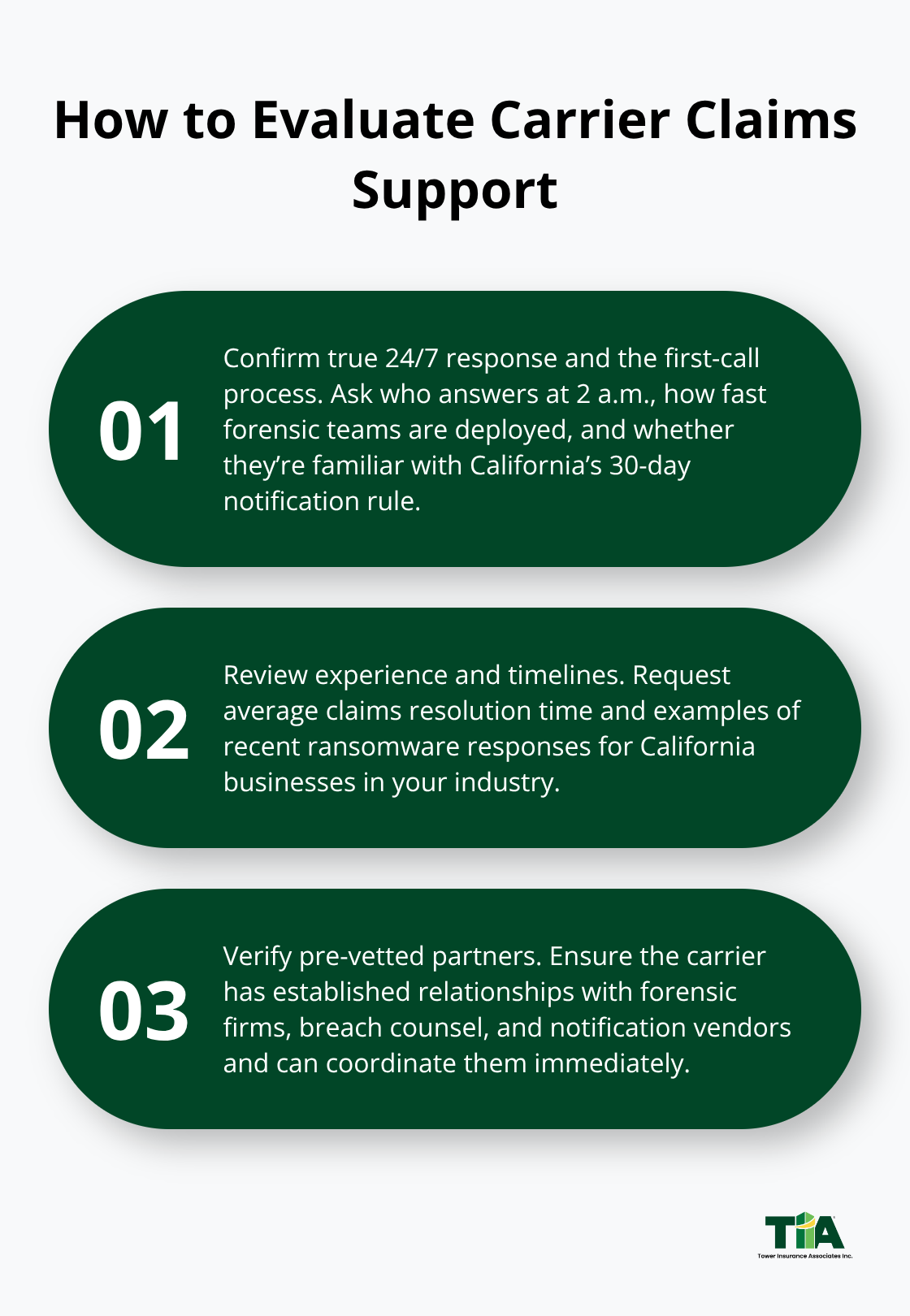
A.M. Best ratings provide carrier financial stability data, and you should accept nothing below an A or A+ rating to guarantee the carrier survives catastrophic loss events. Contact three to five carriers directly and ask specific questions about their breach response protocols, whether they’ve handled California data privacy investigations, and how they coordinate with regulatory agencies.
Work with Local Agents for Better Terms
Local agents who understand California’s unique regulatory environment and have relationships with carriers’ underwriting teams can often negotiate better terms than online quote tools, particularly for mid-sized businesses with complex data handling practices. An independent agency like Tower Insurance Associates, Inc. represents multiple top-rated carriers and can match your specific industry exposure with the right combination of coverage limits, deductibles, and claims support capabilities. This approach typically produces more competitive pricing and stronger coverage terms than shopping carriers individually.
Final Thoughts
Cyber liability insurance protects your California business from the financial devastation that follows data breaches, ransomware attacks, and digital threats. The coverage components we’ve outlined-breach notification costs, business interruption protection, legal defense, and third-party liability-work together to address the specific exposures your business faces in California’s regulated environment. Without comprehensive protection, a single breach costs your business hundreds of thousands of dollars in notification expenses, forensic investigation, regulatory fines, and lost revenue during system downtime.
Your next step involves calculating your actual coverage needs based on the customer records your business maintains and the industry-specific risks you face. A healthcare practice, retail business, or financial services firm handling sensitive data needs different protection levels than a consulting firm with minimal customer information exposure. Once you identify your coverage requirements, compare carriers based on claims support quality and financial stability rather than premium price alone-a carrier that answers your breach response call at 2 a.m. on a Saturday matters far more than saving $500 annually on premiums.
We at Tower Insurance Associates, Inc. help California business owners match their specific industry exposure with the right California business cyber policy, combining coverage limits, deductibles, and claims support capabilities that actually protect your operations. As an independent agency representing multiple top-rated carriers, we negotiate better terms and stronger coverage than you’ll find shopping carriers individually. Contact us today to discuss your cyber liability protection and get properly protected before a breach occurs.
Disclaimer: This blog post is for general informational purposes only and does not represent actual coverage, policy terms, or legal requirements. Insurance details vary by individual and jurisdiction. Please consult a licensed insurance professional for advice specific to your situation.