

One mistake in tax preparation or a missed deduction can trigger a costly lawsuit that threatens your entire practice. E&O for accountants isn’t optional-it’s the safety net that protects you when clients claim you failed to deliver.
At Tower Insurance Associates, Inc., we’ve seen how quickly a single error can spiral into legal fees, settlements, and reputational damage. This guide walks you through what E&O actually covers, the claims you’re most vulnerable to, and the coverage gaps that could leave you exposed.
What E&O Actually Covers
Professional Liability Claims and Defense Costs
E&O insurance for accountants covers three critical areas that directly impact your practice’s survival. First, it pays for your legal defense costs and any settlements or judgments if a client sues you for professional mistakes. When a client alleges you made an error in tax preparation, financial reporting, or advisory services, the insurer handles your lawyer’s fees, court costs, and settlement amounts up to your policy limits. The coverage applies whether the claim goes to court or settles out of court.
Common Sources of Claims
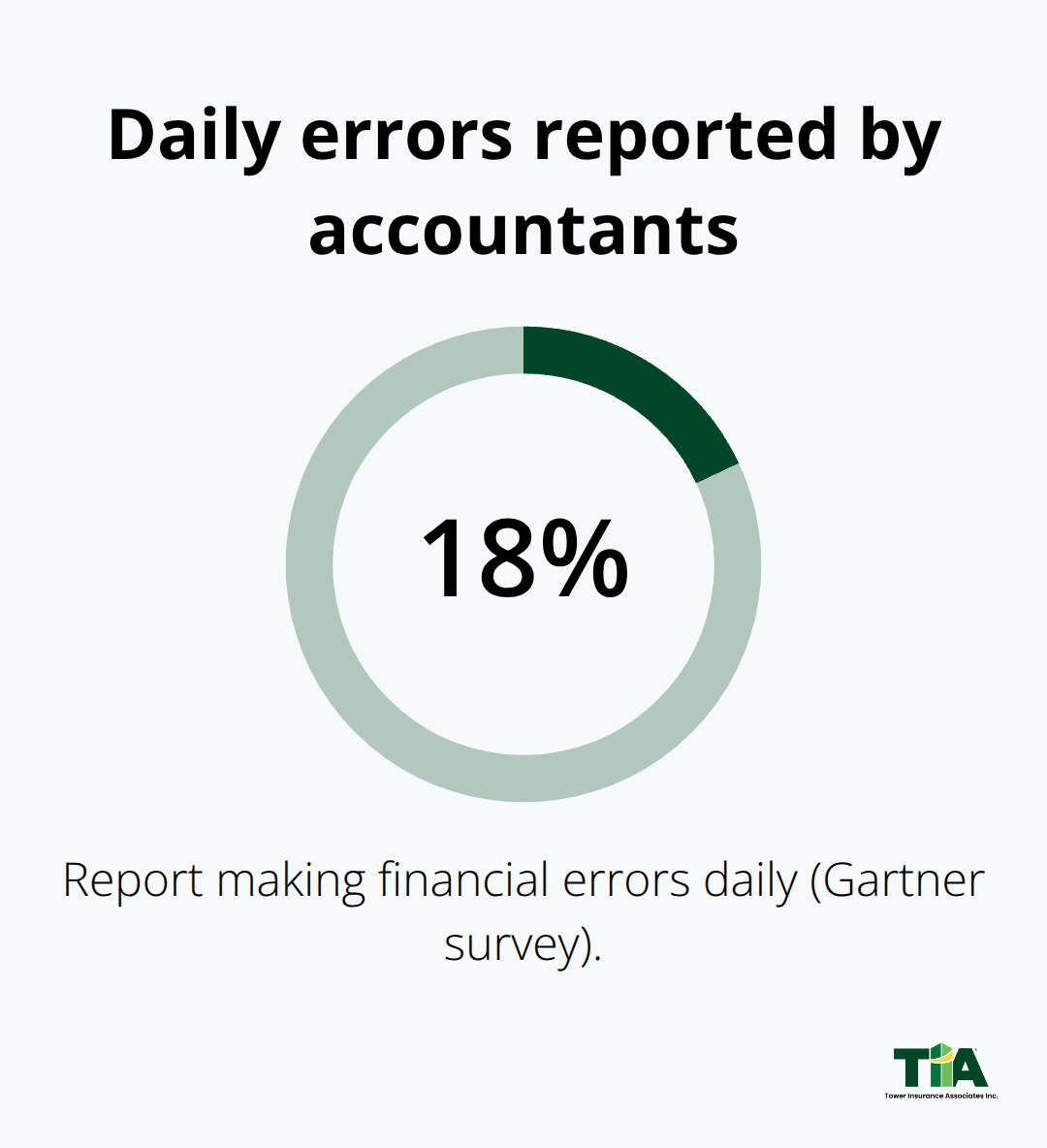
According to Gartner survey findings, 18 percent of accountants report financial errors daily, and a third make errors at least a few times per week-which underscores how realistic these claims are. Second, E&O covers negligence claims arising from tax preparation and financial advice. If you miss a deduction that costs your client money, calculate taxes incorrectly, or provide inaccurate financial guidance that leads to poor business decisions, E&O protects you. These are the most common claims in the profession because they happen frequently in daily work.
Data Security and Confidentiality Coverage
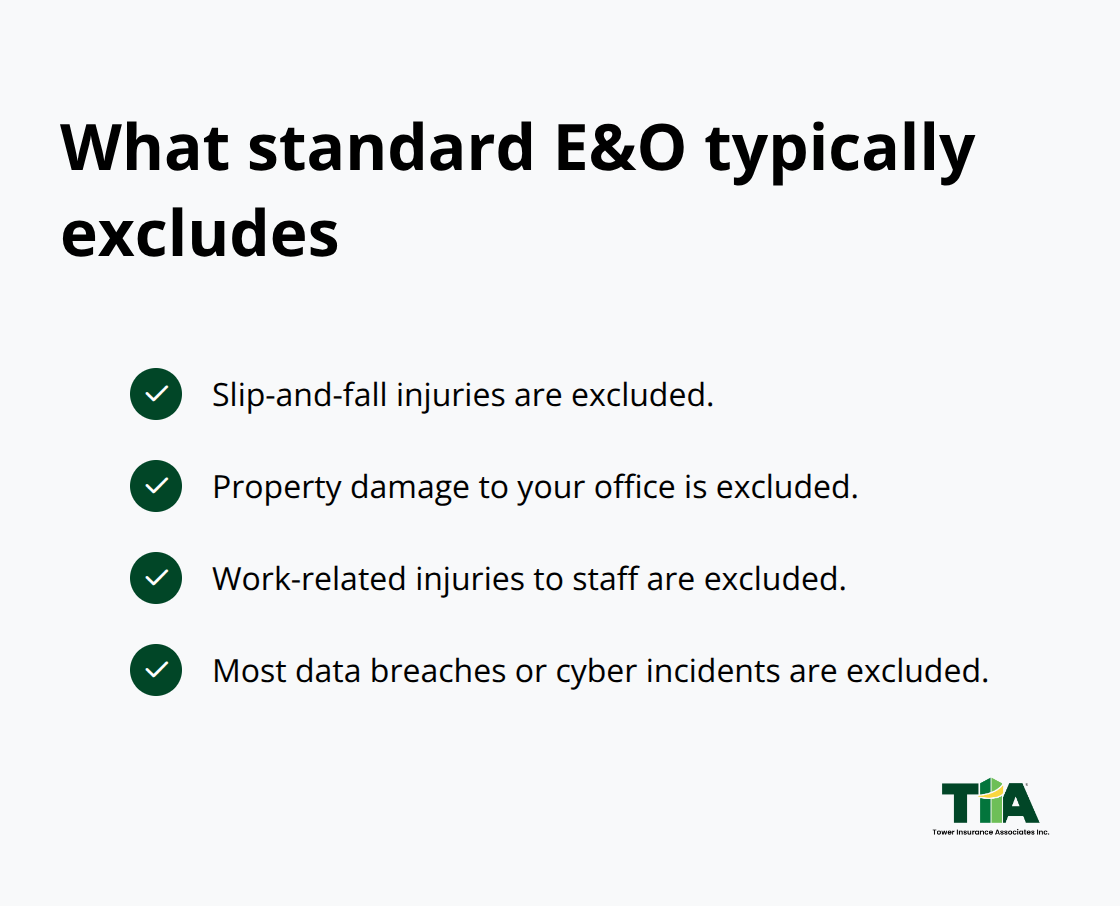
Third, the policy covers breach of client confidentiality and data security issues related to your professional services. If you mishandle sensitive client information or fail to protect their financial data properly, E&O steps in to cover defense costs and related expenses. However, standard E&O does not cover everything. It excludes slip-and-fall injuries, property damage to your office, work-related injuries to staff, and most data breaches or cyber incidents.
Critical Coverage Gaps to Address
If a client suffers a data breach due to a cyber attack on your systems, standard E&O won’t pay for notification costs, credit monitoring, or regulatory fines unless you add Network Security coverage to your policy. You need separate cyber insurance for those risks. Additionally, E&O only covers claims made during your policy period if they relate to work performed after your retroactive date. If you switch insurers, the retroactive date in your new policy determines whether losses from your previous firm can be covered.
Choosing the Right Limits and Deductibles
This is why selecting the right coverage limits matters. Most accounting practices need limits between $1 million and $3 million depending on revenue and client base size. Retention options typically start as low as $500, allowing you to manage deductibles based on your risk tolerance. Pairing E&O with cyber coverage is essential for modern accounting practices that handle client data electronically-and understanding which specific claims trigger the most exposure will help you identify whether your current limits are adequate.
What Really Triggers E&O Claims Against Accountants
Tax Preparation Errors: Documentation Matters More Than You Think
The gap between what accountants think will cause a lawsuit and what actually does is wider than most realize. Tax preparation errors top the list, but not always in the way you’d expect. A missed deduction worth $5,000 rarely generates a claim, but a $50,000 deduction you fail to catch because you don’t ask the right questions absolutely will. The difference lies in documentation and communication. When you don’t document why you excluded a deduction or failed to ask about specific income sources, you’ve created the exact conditions that trigger claims.
According to Gartner survey data, 18 percent of accountants report making financial errors daily, yet most claims stem from errors that could have been prevented with better intake procedures or follow-up questions. Manual data entry introduces significant risk here. Humans typically achieve 96 to 99 percent accuracy in data entry, while automated systems reach approximately 99.99 percent accuracy. That gap compounds across dozens of client files annually. If you still rely on manual entry of income and expense data, you accept unnecessary exposure.
Failure to Identify Financial Irregularities
The second major claim category involves failure to identify financial irregularities that should have raised red flags. A client reports $200,000 in office supply expenses when their business generates only $150,000 in annual revenue. You process it without question. A year later, the IRS audits and discovers the discrepancy. Your client claims you should have caught the obvious inconsistency. E&O covers your defense costs and any settlement, but the claim damages your reputation and ties up your time.
The solution requires implementing threshold alerts and ratio analysis into your review process. If expenses exceed revenue or specific line items spike beyond historical norms, your software should flag them for manual review. This automated approach catches anomalies that manual review might miss, especially when you manage multiple clients simultaneously.
Record-Keeping and Documentation: Your First Line of Defense
Inadequate record-keeping and documentation creates the third vulnerability. Many accountants maintain minimal documentation of client conversations, decisions made during tax planning, or reasons specific strategies were recommended or rejected. When a claim arises three years later, you can’t prove you advised the client against a risky position or explained why you didn’t pursue an aggressive deduction. Without contemporaneous notes, the client’s recollection becomes the default narrative.
Maintain a simple documentation standard for every client engagement, including the date of communication, topics discussed, recommendations made, and client decisions. This takes 90 seconds per conversation but eliminates the “he said, she said” dynamic that makes claims expensive to defend. Firms that implement integrated practice management platforms consolidate client data, communications, and workflows in one location, reducing the risk that critical details get lost between team members.
Building Documentation Into Your Service Delivery
The real protection comes from treating documentation as part of your core service delivery, not an administrative afterthought. When you embed this habit into every client interaction, you create a paper trail that defends you when disputes arise. The next section examines the specific coverage gaps that leave many accountants exposed, even when they carry E&O policies.
Key Coverage Gaps Accountants Should Address
Claims-Made Policies Create Hidden Exposure
Most accountants sign E&O policies without understanding the fundamental difference between claims-made and occurrence coverage, and that ignorance costs practices thousands in unnecessary exposure. A claims-made policy only covers claims reported during the active policy period, regardless of when the work was performed. An occurrence policy covers any incident that happens during the policy period, even if the claim arrives years later. For accountants, claims-made is the standard and the only realistic option from most insurers, which means the retroactive date becomes your actual protection boundary.
If your retroactive date is January 1, 2024, and a client sues you in 2026 for work performed in 2023, that claim falls outside coverage. The retroactive date does not move backward when you renew. You must verify the retroactive date in your renewal documents every single year because some carriers reset it or offer it as a negotiation point.
Retroactive Dates and Policy Switches
If you switch insurers, the new carrier’s retroactive date determines what prior work is covered. A gap of even one month between policies can leave claims unprotected. Prior Acts coverage bridges this gap, but only if you purchase it explicitly and pay the premium. Many accountants assume prior acts coverage is automatic and discover too late that it is not. This single oversight exposes years of prior work to uninsured claims.
Aggregate Limits: When One Claim Exhausts Your Protection
Your aggregate limits and retention strategy directly impact your financial exposure in ways that most accountants misunderstand. The aggregate limit is the total amount the insurer pays across all claims during the policy year. If your aggregate is $1 million and you face two claims worth $600,000 and $500,000, the insurer pays the first claim fully but only $400,000 on the second, leaving you responsible for $100,000. This happens more often than accountants expect because one major claim does not preclude others from surfacing in the same year.
Retention Strategy: The Math Behind Deductible Choices
Retention, or deductible, starts as low as $500 but many practices choose $2,500 or $5,000 to reduce premiums. Lower retention means you pay less out of pocket when claims occur, but higher retention lowers your annual premium cost. The math matters here. If you save $800 annually by choosing a $5,000 retention instead of $500, and you face a claim once every five years on average, you save $4,000 in premiums while accepting $4,500 more in deductible risk.
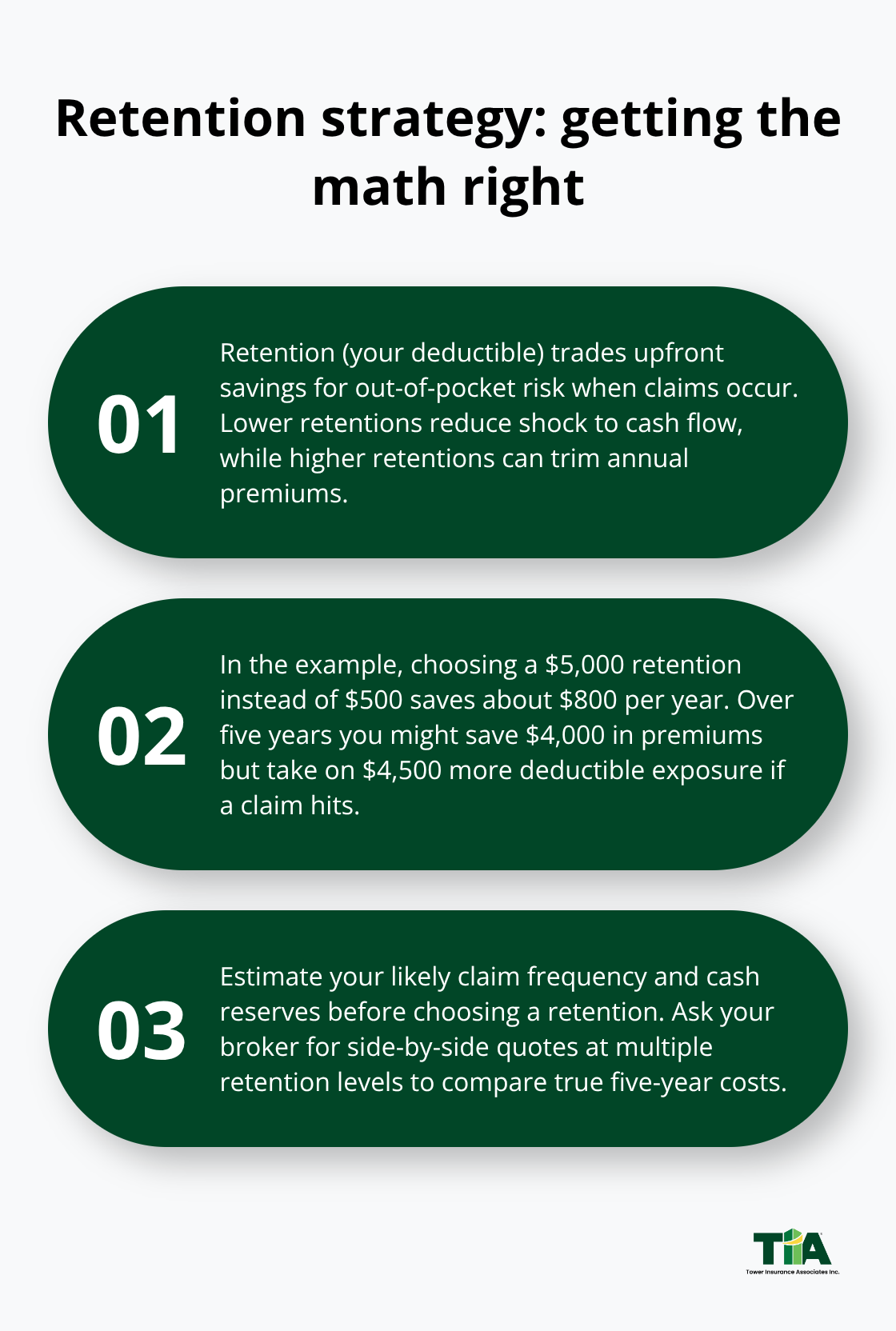
The break-even calculation is personal to your practice size and claims history. Firms with fewer than five employees typically benefit from lower retentions because a single claim can strain cash flow. Larger firms with established loss reserves can absorb higher retentions for premium savings. Request a comparison quote showing three retention options with corresponding premiums so you can calculate the true cost of each scenario over five years rather than making the decision based on this year’s premium alone.
Final Thoughts
E&O for accountants protects your practice when errors occur, but only if you structure the policy correctly and address coverage gaps before claims arrive. Most accountants discover gaps after they need coverage, which proves too late to help. Start by reviewing your current policy to verify your retroactive date, confirm prior acts coverage exists, and calculate whether your retention strategy actually saves money over five years rather than just reducing this year’s premium.
Pair your E&O policy with cyber insurance immediately if you haven’t already, since standard E&O excludes data breaches and cyber incidents that can cost $100,000 or more per breach. The combination of both coverages creates the comprehensive protection modern accounting practices require. An experienced insurance advisor helps you match coverage to your actual exposure and avoid the gaps that leave practices vulnerable.
We at Tower Insurance Associates, Inc. represent multiple top-rated carriers and specialize in tailored coverage for accounting practices. Contact Tower Insurance Associates, Inc. to review your current coverage and strengthen your protection against the errors that happen regularly across the profession.
Disclaimer: This blog post is for general informational purposes only and does not represent actual coverage, policy terms, or legal requirements. Insurance details vary by individual and jurisdiction. Please consult a licensed insurance professional for advice specific to your situation.