
Small and medium-sized businesses face a relentless wave of cyber attacks. In 2024, SMBs experienced a 62% increase in ransomware incidents compared to the previous year, yet most lack the resources to defend themselves effectively.
At Tower Insurance Associates, Inc., we know that cyber risk management services are no longer optional-they’re essential. A strong cyber liability strategy combines vulnerability assessments, security controls, and incident response planning to protect what you’ve built.
Why SMBs Are Targets
SMBs have become primary targets for cybercriminals, and the numbers prove it. According to Verizon’s 2025 Data Breach Investigations Report, the team analyzed 22,052 real-world security incidents, of which 12,195 were confirmed data breaches that occurred inside organizations. About 70% of those breaches involve external cybercriminals, meaning your business faces active, deliberate attacks from organized threat actors. The reason is straightforward: SMBs often lack the security infrastructure of larger enterprises, making them easier to penetrate and exploit for profit or data theft.
The Resource Reality
Most SMBs operate without formal risk management frameworks. Only 14% have established one, while roughly 74% operate entirely without structured risk programs.
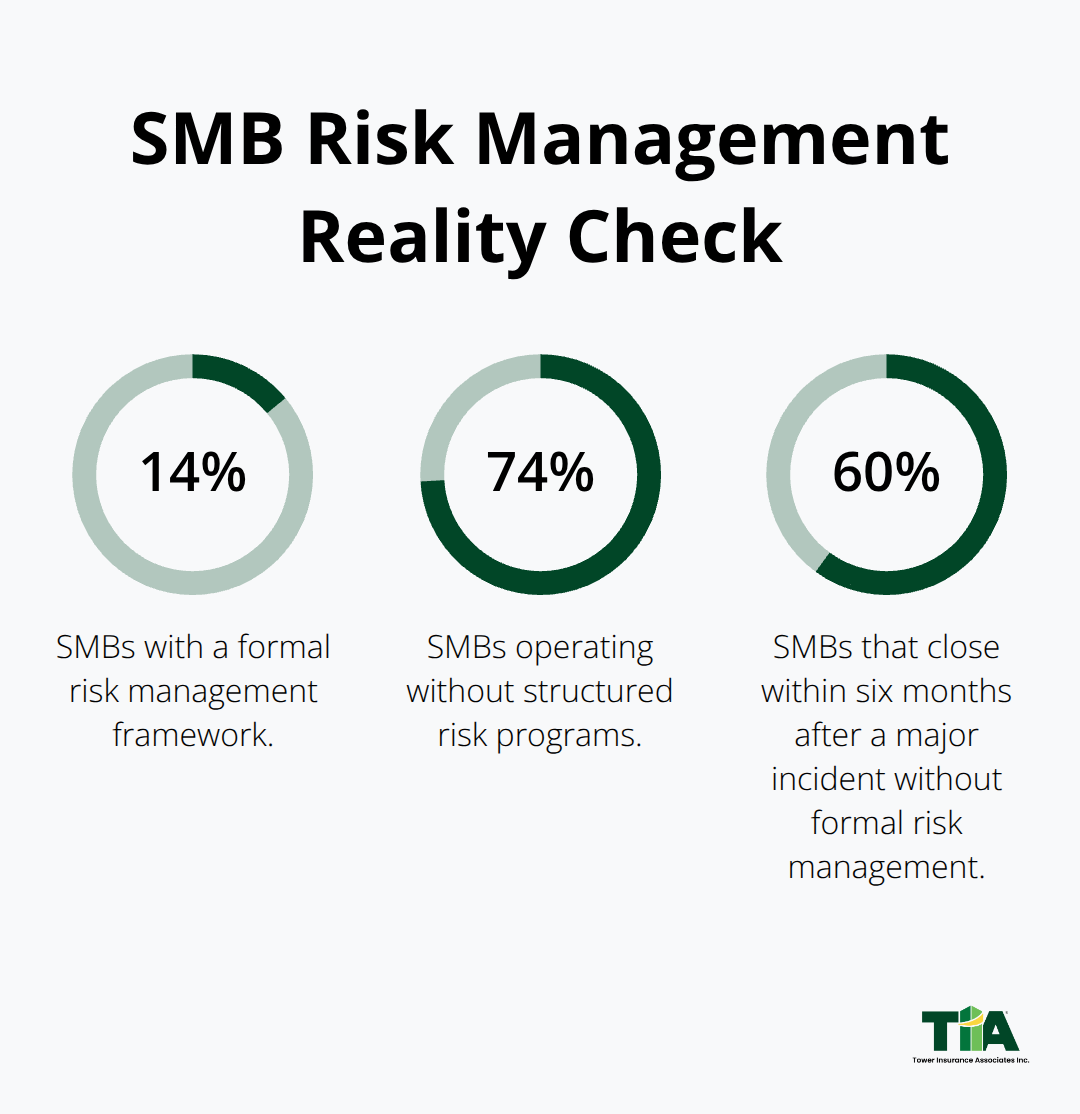
This gap matters because it directly affects your ability to detect and respond to threats. When a breach occurs, the consequences are severe. According to the IBM Cost of a Data Breach Report 2025, the average global data breach costs $4.88 million. However, organizations with mature risk management programs reduce those costs to approximately $2.59 million-a potential savings of $2.29 million. The difference isn’t just financial; 60% of SMBs close within six months after a major incident when risk management is not formally established. A single breach can end your business entirely. Most SMBs cannot afford dedicated security staff. Cyber insurance premiums have risen 50–100% for organizations without documented risk management, making the cost of staying unprotected both operationally and financially unsustainable.
Regulatory Requirements Are Tightening
Compliance pressures continue to intensify across industries. The FTC has issued Safeguards Rule penalties exceeding $50 million since 2021, and enforcement has accelerated. These penalties require documented risk assessments and specific security controls. If you handle customer data, payment information, or operate in regulated sectors, non-compliance isn’t just a legal risk-it’s a business-ending one. Cyber insurance carriers now demand evidence of controls before issuing policies. Insurers require verified implementation of multi-factor authentication, endpoint detection and response, immutable backups, and documented incident response plans. Without these controls, you either cannot obtain coverage or pay dramatically higher premiums. Understanding which controls satisfy both regulatory requirements and insurer mandates helps you invest in protections that work double duty.
What Comes Next
These pressures-limited resources, active threats, and regulatory demands-create a clear imperative. Your business needs a structured approach to cyber risk that addresses vulnerabilities before attackers exploit them. The next section outlines the core components of a strong cyber liability strategy and shows how to build defenses that actually work.
Building a Cyber Risk Program That Actually Works
A strong cyber liability strategy isn’t about buying the most expensive tools or chasing every headline threat. It’s about understanding what you have, protecting it systematically, and knowing exactly what to do when something goes wrong. The most effective programs start with three concrete actions: mapping your vulnerabilities, deploying controls that reduce real attack vectors, and preparing to respond faster than attackers can cause damage.
Start With What You Actually Have
You cannot protect what you don’t know exists. Most SMBs skip asset discovery entirely, which is why 70% of SMBs rely on outside experts to guide security decisions and why monitoring gaps remain a primary breach driver. Inventory every device, application, cloud service, and data repository your team uses. Include employee laptops, mobile devices, servers, databases, cloud subscriptions, and even dormant accounts that still have access. The CIS Hardware and Software Asset Tracker is a free tool designed for this purpose. Once you know what you’re protecting, prioritize by criticality: which systems handle customer data, payment information, or intellectual property? Which systems, if taken offline, would halt operations? This prioritization drives everything that follows. Without it, you waste resources protecting low-risk assets while leaving critical systems exposed. Document this inventory and update it quarterly as your business adds tools, employees, and cloud services.
Deploy Controls That Counter Real Attacks
Phishing remains the dominant attack vector in real-world breaches. According to Verizon’s 2025 Data Breach Investigations Report, phishing-related breaches account for 27% of confirmed incidents affecting SMBs. This means your first control must be multi-factor authentication on all external entry points-email, remote access, administrative accounts, and cloud applications. Microsoft data shows that phishing-resistant MFA using FIDO2 or WebAuthn blocks approximately 99.9% of automated attacks. This single control eliminates the majority of credential-based breaches and is now required by most cyber insurance carriers. Deploy unified endpoint detection and response across all laptops, desktops, and servers. EDR continuously monitors for malicious behavior and enables rapid containment if a device is compromised. Establish immutable offline backups with tested restore procedures. Ransomware now steals data before encrypting systems, imposing very short extortion deadlines-often 24 to 48 hours. Backups that cannot be encrypted, modified, or deleted by attackers are your only guaranteed recovery path. Test restores quarterly to confirm they actually work.
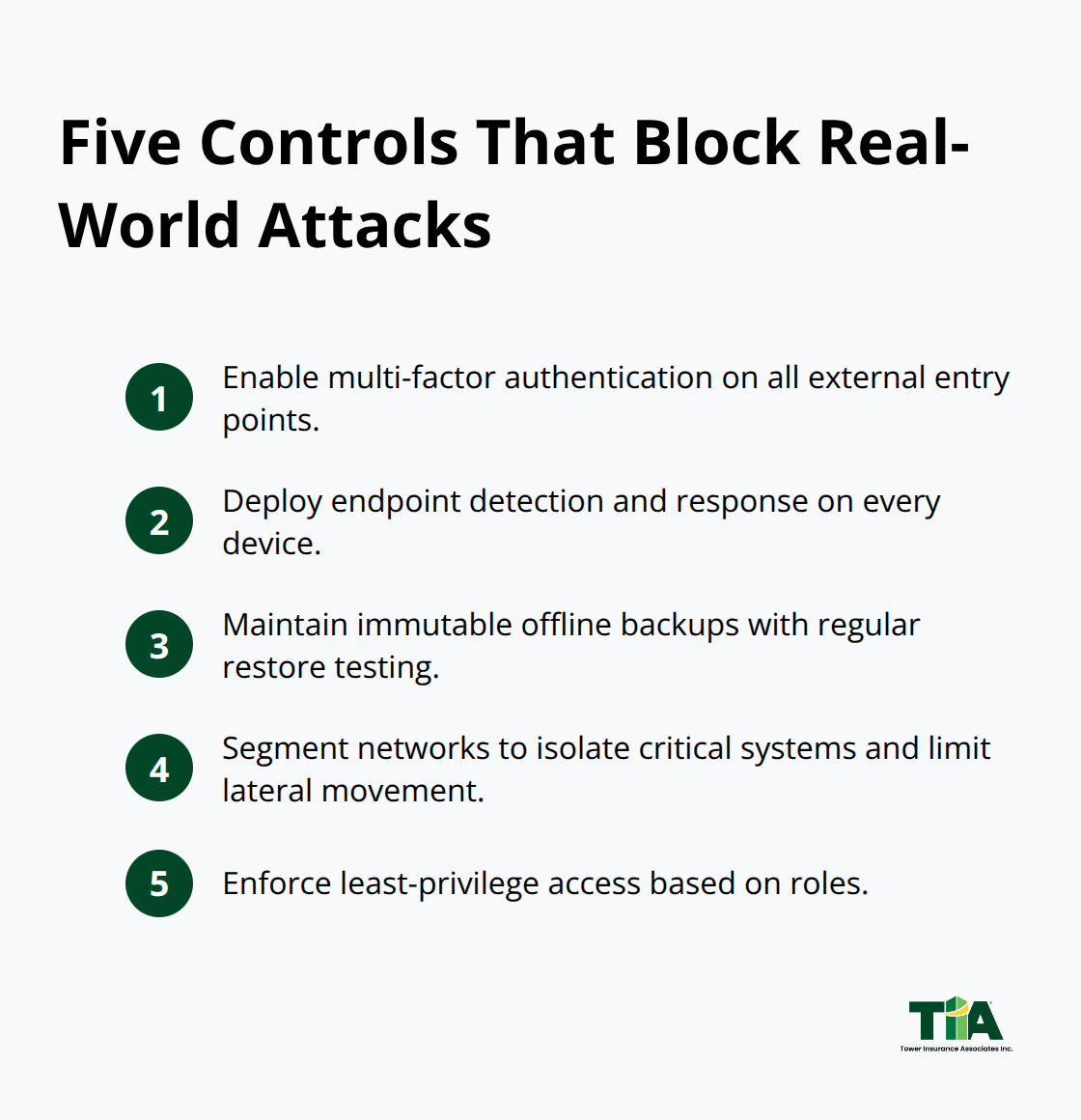
Implement network segmentation to isolate critical systems and limit lateral movement if an attacker gains initial access. Enforce least-privilege access so employees have only the permissions necessary for their role, and disable legacy authentication protocols that lack modern security features. These five controls-MFA, EDR, immutable backups, network segmentation, and least-privilege access-address the breach vectors that actually affect SMBs today, not hypothetical future threats.
Plan for Detection and Response Before You Need It
Detection speed matters enormously. Organizations with mature risk programs detect breaches 38% faster and contain them 42% faster than those without formal programs, according to IBM’s Cost of a Data Breach Report 2025. This speed difference translates directly to reduced damage and lower recovery costs. Establish 24/7 centralized logging that aggregates events from firewalls, email systems, network devices, and endpoints into a single searchable repository. This enables your security team-whether internal staff or a managed security provider-to spot anomalies before attackers establish persistence. Define key risk indicators that trigger investigation: a spike in failed login attempts, a device communicating with known malicious IP addresses, a user accessing data outside their normal behavior, or unusual file activity on critical systems. Document your incident response plan in writing, assign roles and responsibilities, and conduct tabletop exercises at least twice per year to validate it. Include legal and public relations from the start so notification timelines and communication strategies are pre-approved. Many SMBs wait until a breach occurs to figure out who to call and what to say-by then, the window for containment has closed and regulatory notification deadlines are already ticking.
Connect Risk Management to Insurance Requirements
Your cyber liability insurance policy now shapes your security posture. Insurers require verified implementation of specific controls before they issue coverage or renew policies. Most carriers mandate MFA, EDR, immutable backups, and documented incident response plans. When you align your risk program with these insurer requirements, you accomplish two goals simultaneously: you reduce your actual breach probability and impact, and you satisfy the conditions that keep your premiums competitive. This alignment also matters when you file a claim. Insurers investigate whether you maintained the controls your policy required. If you skipped MFA or never tested your backups, the carrier may deny or reduce your claim payout. A formal risk program with documented controls, regular testing, and clear ownership creates the evidence trail that supports both coverage eligibility and successful claims.
The controls you’ve now deployed and the detection capabilities you’ve established form the foundation of your cyber liability strategy. What remains is translating this technical foundation into measurable business outcomes and understanding how cyber risk management services accelerate your progress toward a resilient operation.
How Cyber Risk Management Services Close Your Protection Gaps
SMBs struggle with the operational reality of cyber defense. Your team is stretched thin, your IT staff juggles dozens of competing priorities, and the technical landscape shifts faster than internal resources can adapt. This is where cyber risk management services become operationally necessary.
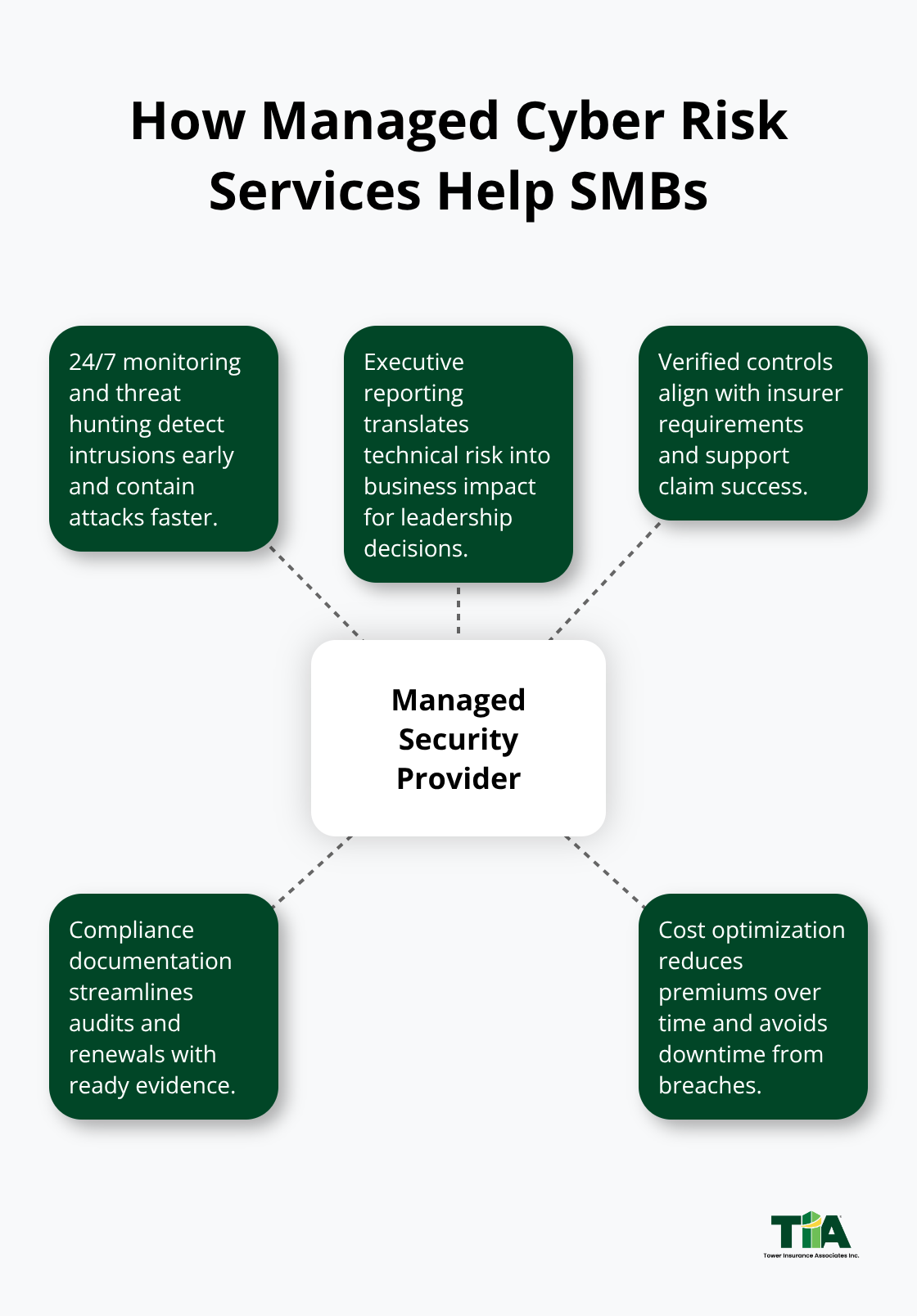
A dedicated managed security provider handles the continuous work that your business cannot sustain alone, translating the controls you’ve deployed into active, around-the-clock threat detection and response.
Real-Time Monitoring Catches Attacks Before They Spread
Organizations with 24/7 centralized monitoring and professional threat hunting detect breaches 38% faster and contain them 42% faster than those relying on internal teams working business hours, according to IBM’s Cost of a Data Breach Report 2025. That speed difference means the difference between a contained incident affecting a few systems and a full-scale ransomware deployment that shuts down operations for weeks.
A managed security provider monitors your firewalls, endpoints, email systems, and network devices in real time, aggregating logs from all sources into a single searchable repository. When an anomaly surfaces-a device communicating with a known malicious IP address, a user accessing sensitive data outside their normal behavior, or a spike in failed login attempts-your provider’s security operations center investigates immediately rather than waiting for your internal team to notice during business hours. This continuous vigilance catches attacks in their early stages before attackers establish persistence, steal data, or deploy ransomware.
Executive Reporting Translates Technical Risk Into Business Language
A strong risk management partner provides quarterly executive reporting that translates technical findings into business risk language. Your leadership sees which vulnerabilities pose the highest threat to revenue, operations, and regulatory compliance. This reporting also creates the documented evidence that cyber insurance carriers demand when evaluating your risk posture and when processing claims.
When you file a claim after a breach, your insurer investigates whether you maintained the controls your policy required. A managed provider supplies the technical evidence-logs showing EDR was active, backup restore tests that succeeded, MFA enforcement records-that supports your claim. Without this documentation, carriers deny or reduce payouts even when you believed you were covered.
Verified Controls Satisfy Insurance Requirements
Risk management services bridge the critical gap between your technical controls and your cyber liability insurance requirements. Insurers now demand verified implementation of specific controls: MFA across all external entry points, EDR on every endpoint, immutable offline backups with documented restore testing, and a written incident response plan with assigned roles. A managed provider confirms these controls actually function, not just theoretically exist.
Many SMBs discover after a breach that their backup system was misconfigured, their EDR agent was disabled on critical servers, or their MFA implementation had gaps on legacy systems. A dedicated provider conducts regular vulnerability assessments to identify exactly which systems lack required controls, then guides remediation with specific timelines and priority sequencing. This assessment-driven approach prevents the costly surprises that emerge during claims investigation.
Compliance Documentation Reduces Audit Risk
Your provider maintains compliance documentation that satisfies regulatory requirements. If you handle customer data or operate in regulated sectors, auditors and regulators expect to see evidence of ongoing risk assessment, control testing, and incident response readiness. A managed security partner generates the reports, audit trails, and compliance artifacts that demonstrate your due diligence. This documentation also becomes critical when negotiating cyber insurance renewal.
Carriers increasingly price policies based on verified risk posture rather than industry averages. Organizations with documented controls, continuous monitoring, and successful backup restores pay significantly lower premiums than those without formal programs. Over a three-year policy cycle, the premium difference often exceeds the cost of the managed service itself, making the investment financially self-sustaining.
Final Thoughts
The cyber threats facing your SMB are real, measurable, and accelerating. Phishing attacks account for 27% of confirmed breaches, ransomware steals data before encryption, and regulatory penalties exceed $50 million annually. Yet the path forward is clear: a structured cyber risk management program reduces breach costs by nearly $2.3 million and cuts breach likelihood by 53%.
Start with asset inventory, deploy MFA on all external entry points, establish unified endpoint detection and response, create immutable offline backups, and implement network segmentation. Pair these controls with 24/7 centralized monitoring so you detect threats before they spread and maintain the documented evidence your cyber insurance carrier demands. Organizations with mature risk programs detect breaches 38% faster and contain them 42% faster, translating directly to lower recovery costs and reduced downtime.
Your competitors without formal risk programs face escalating insurance costs, regulatory exposure, and breach probability. At Tower Insurance Associates, Inc., we help SMBs align their cyber risk management services with insurance requirements and competitive coverage. Contact Tower Insurance Associates, Inc. to discuss how cyber liability coverage protects what you’ve built.
Disclaimer: This blog post is for general informational purposes only and does not represent actual coverage, policy terms, or legal requirements. Insurance details vary by individual and jurisdiction. Please consult a licensed insurance professional for advice specific to your situation.